
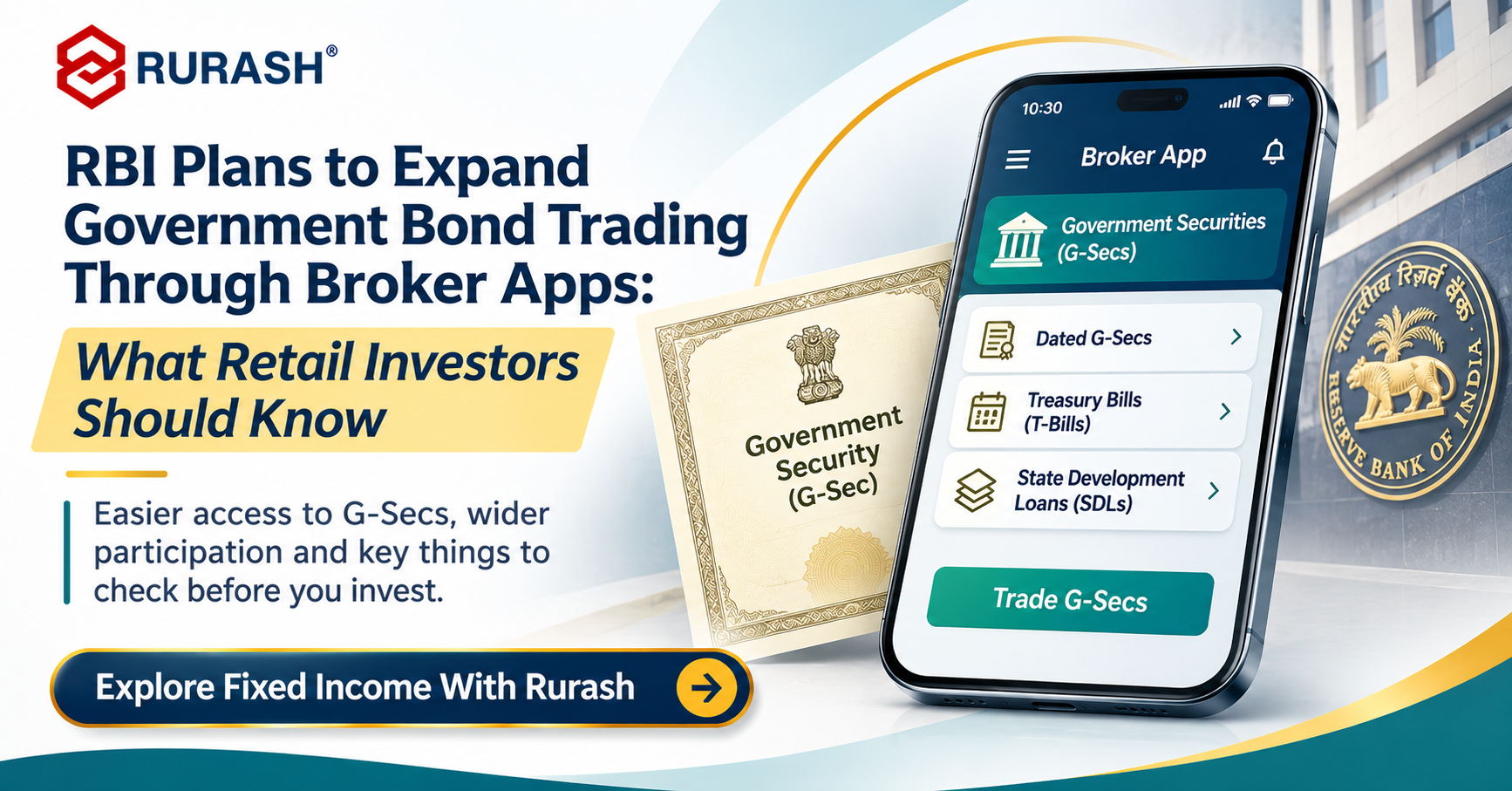
You can buy shares through a trading app. Could buying government bonds soon become just as convenient?
For many Indian investors, purchasing shares or mutual funds through a mobile application has become a familiar experience.
Government securities, however, have traditionally attracted greater participation from banks, insurance companies, pension funds and institutional investors.
Although retail investors already have access to government bonds through the Reserve Bank of India’s Retail Direct platform and certain other permitted channels, government securities remain less familiar than equities or fixed deposits.
That could gradually change.
On 23 November 2026, Reuters reported that the Reserve Bank of India (RBI) is planning to expand retail access to government securities through online brokerage applications, potentially making government bond trading more accessible to individual investors in 2027.
The reported development is part of a broader effort to encourage retail participation and deepen India’s government securities market.
For investors, easier access raises an important question.
If government bonds become easier to purchase and sell, does that automatically make them more suitable for every investor?
The answer depends on understanding bond yields, market prices, maturity, liquidity and the role of government securities in a diversified portfolio.
What Happened? RBI Is Exploring Wider Access to Government Bond Trading
According to Reuters reporting on 23 November 2026, the RBI is considering ways for online brokerage platforms to offer retail investors more convenient access to government securities trading.
The reported expansion could help investors discover and trade eligible debt securities through interfaces resembling the brokerage applications they already use for equities.
However, this is not an entirely new concept.
The RBI introduced the Stock Broker Connect facility under its NDS-OM access framework in 2025, creating a regulated mechanism for access through stockbrokers. The November 2026 development concerns potentially expanding practical retail reach through brokerage applications.
The reported 2027 expansion should not be presented as a fully implemented facility available through every stockbroker today.
RBI GOVERNMENT BOND TRADING — KEY NUMBERS
Retail Direct participants
4.03 lakh
Around mid-November 2026
Retail Direct holdings
₹4,885 Cr
Reported value
Participants in Dec 2022
67,000
Possible broader access
2027
Reported plan, not launch date
Source: Reuters, 23 November 2026. Participant figures are approximate, and the planned brokerage-app expansion remains subject to further developments.
1. What Are Government Securities?
Government securities, commonly known as G-Secs, are debt instruments issued by the Central Government or state governments to raise funds.
When an investor purchases a government security, they are effectively lending money to the relevant government issuer.
Depending on the instrument, the investor may receive periodic interest payments or earn a return through the difference between the purchase and redemption amounts.
Government securities cover several instruments.
| Instrument | Main characteristic |
|---|---|
| Treasury Bills (T-Bills) | Short-term Central Government securities, typically issued at a discount and redeemed at face value |
| Dated Government Securities | Central Government bonds with specified maturities and coupon terms |
| State Government Securities (SDLs) | Debt securities issued by state governments |
| Sovereign Gold Bonds (existing issuances) | Gold-linked government securities with separate features and eligibility conditions |
Central Government securities are generally considered to have very low domestic-currency default risk because they are obligations of the sovereign.
However, investors can still face interest-rate, market-price and liquidity risks, especially when selling before maturity.
2. How Can Retail Investors Buy Government Bonds Today?
Individual investors already have direct access to several government securities through the RBI Retail Direct Scheme.
Launched in November 2021, the scheme allows eligible individuals to open a Retail Direct Gilt account and participate in government securities markets.
Investors can use the platform to participate in eligible primary auctions and undertake secondary-market transactions through the available NDS-OM facilities.
The official platform is RBI Retail Direct.
The RBI has also developed other market-access arrangements, including the Stock Broker Connect mechanism.
Therefore, the latest reported proposal is best understood as another step towards wider and more convenient access, rather than the first opportunity for retail investors to purchase government bonds.
3. Why Does the RBI Want More Retail Participation?
Government securities form an important part of India’s financial system.
They provide a mechanism for government borrowing and serve as a reference point for pricing other debt instruments.
Historically, major institutional investors have accounted for a substantial proportion of government securities holdings and trading activity.
Increasing individual participation can potentially diversify the investor base.
It may also encourage more investors to consider fixed-income products as part of their financial planning.
A wider investor base could gradually support market activity, although higher participation does not automatically translate into greater liquidity for every individual security.
Making government securities easier to understand and access is therefore one part of developing a broader market.
4. What Could Brokerage-App Access Change?
A more familiar digital trading experience could reduce some of the practical barriers faced by retail investors.
For example, an investor accustomed to using an online brokerage platform may find it easier to explore eligible bonds if quotations, maturity details and transaction facilities become available through the same interface.
Depending on the eventual platform arrangements, investors might benefit from simpler navigation, more accessible investment information and more convenient execution.
However, the actual benefits will depend on the final operating model.
Investors will need clarity on the securities offered, account arrangements, applicable charges, execution procedures and settlement safeguards.
The convenience of an application should not become the sole basis for choosing a security.
A simpler buying process does not remove the need to understand the investment.
5. Government Bond Coupon vs Yield: Why the Difference Matters
One of the most important concepts in bond investing is the distinction between coupon rate and yield.
The coupon rate describes the interest payment specified in a bond’s terms, generally as a percentage of face value.
Yield reflects the relationship between the bond’s purchase price and its expected cash flows.
Suppose a government bond has a face value of ₹1,000 and an annual coupon of 7%.
Assuming annual payments, it pays ₹70 each year.
But an investor purchasing that bond in the secondary market may pay more or less than ₹1,000.
If the bond is purchased at a premium, its yield to maturity may be lower than its coupon rate.
If purchased at a discount, its yield may be higher, depending on remaining maturity and other cash-flow terms.
Illustrative bond-price comparison
| Face value | ₹1,000 |
|---|---|
| Annual coupon | ₹70 |
| Purchase price A | ₹950 |
| Purchase price B | ₹1,050 |
Although both purchases involve the same stated coupon, the implied yields differ because the amounts invested differ. A precise yield-to-maturity calculation also requires remaining maturity and the payment schedule.
Hypothetical figures, not a live government bond quotation or return forecast.
Investors evaluating government securities through trading apps should therefore look beyond the prominently displayed coupon.
6. Can Government Bond Prices Fall?
Yes.
Government securities may have low sovereign credit risk, but their market prices can fluctuate.
Bond prices and market yields generally move in opposite directions.
When prevailing yields rise, the prices of existing fixed-rate bonds typically decline, all else being equal.
When yields fall, existing bond prices may rise.
The effect can be more pronounced for longer-duration securities.
An investor who purchases a long-term government bond and then needs to sell it before maturity may receive less than the original purchase price.
This is why maturity and duration are important considerations.
Government backing does not mean that every secondary-market sale will be profitable.
7. Does Easier Trading Guarantee Better Liquidity?
Not necessarily.
Liquidity refers to the ability to buy or sell an instrument without significantly affecting its price.
A more accessible trading interface may help investors discover potential buyers and sellers.
However, the actual ability to execute a transaction depends on trading interest, available quotations, transaction size and market conditions.
Some government securities may trade more actively than others.
Investors selling relatively illiquid securities may encounter wider bid-ask spreads or limited available market depth.
The bid-ask spread is the difference between the price at which a buyer is willing to purchase and a seller is willing to sell.
A large spread can increase transaction costs.
The proposed expansion of brokerage-app access should therefore be viewed as a potential improvement in market participation, not a promise of guaranteed liquidity.
8. Government Bonds vs Fixed Deposits: Are They the Same?
Government securities and bank fixed deposits are different financial products.
A fixed deposit generally has an agreed interest rate and maturity arrangement with the bank, subject to its terms.
Government securities may be purchased in primary auctions or through secondary trading, where market prices can change.
Investors selling a government bond before maturity may realise a capital gain or loss depending on the market price and transaction costs.
The credit and regulatory characteristics also differ.
For example, eligible bank deposits are covered by the applicable deposit insurance framework up to prescribed limits, while Central Government securities are sovereign obligations.
Investors should compare both products according to maturity, income requirements, liquidity and overall financial objectives.
9. Can Senior Citizens Benefit From Wider Bond Access?
Potentially.
Senior citizens may consider government securities as one component of an income-oriented investment portfolio.
Certain dated government securities provide periodic coupon payments, which can be useful for planning expected cash inflows.
However, the maturity dates may extend well beyond the investor’s near-term financial requirements.
An investor depending on savings for healthcare and household expenses should consider whether sufficient liquid resources are available outside long-duration bonds.
It is also important to understand the tax treatment of coupon income and any gains or losses.
A more convenient purchasing process cannot replace retirement-income planning.
10. What About Treasury Bills?
Treasury Bills are short-term Central Government debt instruments.
Unlike conventional coupon-bearing dated securities, T-Bills are generally issued at a discount and redeemed at face value.
For example, an investor may purchase a T-Bill for less than its face value and receive the face value at maturity, subject to the applicable terms.
The difference represents the investment return before taxes and other relevant costs, assuming the instrument is held to maturity.
Because T-Bills have relatively short maturities, they may serve different financial needs from longer-duration government securities.
However, investors should still consider the actual purchase price, maturity and liquidity requirements.
11. What Does the Development Mean for Bond Markets?
Expanding retail distribution could potentially support greater awareness and participation in India’s government securities market.
A larger and more diverse investor base may help broaden demand across eligible securities.
However, the effect on trading volumes, market depth and price discovery cannot be determined before the proposed arrangements are implemented.
Institutional investors are likely to remain important participants in government securities markets.
For retail investors, the immediate significance is greater potential accessibility rather than a predictable movement in bond yields.
There is no reason to assume that allowing more brokerage apps to offer government securities will automatically raise or lower government bond prices.
12. What Should Investors Check Before Buying G-Secs Through a Trading App?
| What to review | Investor question |
|---|---|
| Issuer | Is this a Central Government or state government security? |
| Instrument | Is it a T-Bill, dated G-Sec or SDL? |
| Coupon | What interest payments are specified? |
| Yield | What return is implied by the actual purchase price? |
| Maturity | When is the principal scheduled to be repaid? |
| Duration | How sensitive is the price to changes in yields? |
| Liquidity | Are there reasonable buy and sell quotations? |
| Charges | What platform, execution and other costs apply? |
| Taxation | What is the applicable tax treatment? |
| Portfolio suitability | Does the investment match my time horizon and cash needs? |
Investors should also verify that the chosen trading channel is authorised and that the relevant features are actually operational.
Ranjit Jha’s Perspective — Draft for Approval
Proposed editorial perspective for Ranjit M. Jha, MD & CEO, Rurash Financials. Approval required before attribution.
Greater accessibility to government securities can support wider participation in India’s fixed-income markets.
The RBI’s reported plans to expand government bond trading through brokerage applications could make these instruments more familiar to retail investors.
However, accessibility should be accompanied by an understanding of coupon rates, market yields, duration and liquidity.
Government securities can play a role in investment portfolios, but their suitability depends on an investor’s financial objectives, income requirements and investment horizon.
The objective should be to improve informed participation rather than encourage investors to treat government bonds as products without market risk.
The Bigger Picture: More Accessible Bonds Require Better Investor Awareness
India’s government securities market has traditionally been dominated by institutional participation.
The RBI Retail Direct Scheme and subsequent market-access arrangements have already created new opportunities for individual investors.
The proposed expansion through brokerage applications could make government securities more visible to investors accustomed to digital financial platforms.
However, the underlying investment characteristics remain unchanged.
Bond prices can fluctuate, longer-duration securities can experience meaningful interest-rate sensitivity, and secondary-market liquidity may differ between issues.
The important change may be how easily investors can access government bonds. The important investment decision remains whether the bonds suit their financial needs.
Explore More with Rurash
At Rurash Financials, we believe fixed-income investment decisions should begin with a clear understanding of yield, maturity, credit quality and liquidity.
For retail investors, senior citizens, HNIs and business owners exploring government securities, selecting an appropriate instrument requires evaluating financial objectives and investment horizons.
Through our Fixed Income Investment services, eligible investors can explore government bonds, corporate bonds and other suitable fixed-income opportunities.
Easier bond trading creates access. Better bond understanding supports informed investing.
Connect With Rurash Financials
Connect with Rurash Financials Pvt. Ltd. to discuss how government bond yields, maturity choices and interest-rate movements can affect your fixed-income allocation.
Disclaimer: This article is intended for general investor education and does not constitute personalised investment advice or a recommendation to purchase any specific government security. Bond prices may fluctuate, and early sales can result in capital losses. The broader brokerage-app access reported on 23 November 2026 remains a reported plan, not a confirmed universal launch.