
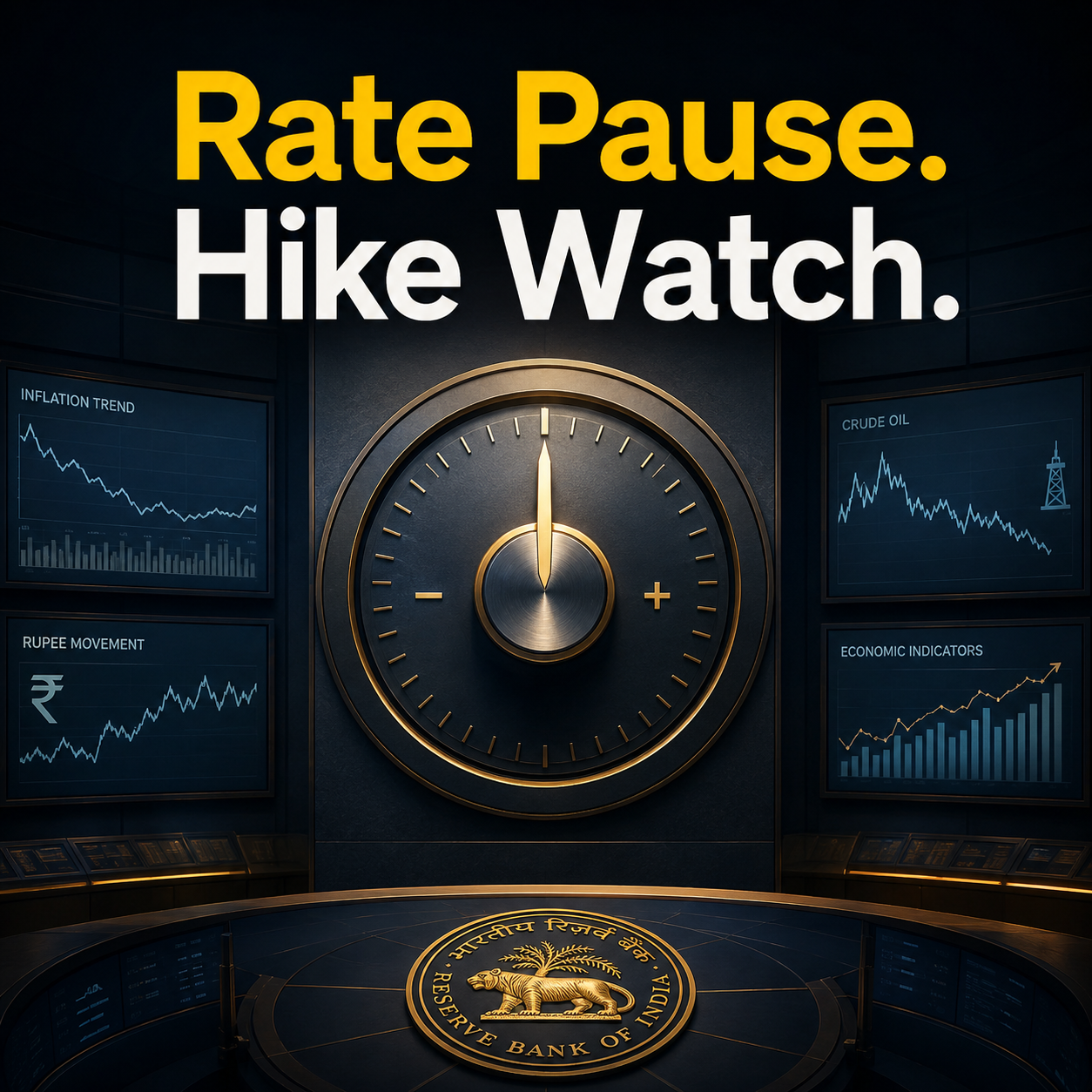
RBI Monetary Policy: Rate Pause, Future Hike Watch
Why Investors Should Watch the Next Move Carefully
The Reserve Bank of India has chosen caution over aggression.
In its latest monetary policy decision, the RBI kept the repo rate unchanged at 5.25% while maintaining a neutral policy stance. The move signals that the central bank is neither rushing toward tightening nor committing to prolonged rate stability.
For investors, this is more than just a policy announcement.
It is a signal that the interest-rate cycle remains data-dependent, and future decisions could be influenced by inflation, crude oil prices, currency movements, and global economic developments.
Why The RBI Chose To Pause
India’s economic backdrop remains balanced but complex.
On one hand, economic growth continues to show resilience, supported by domestic consumption, infrastructure spending, and improving corporate balance sheets.
On the other hand, policymakers remain cautious about:
Crude oil volatility
Geopolitical developments
Food inflation risks
Currency fluctuations
Global interest-rate trends
A premature rate hike could slow growth momentum, while delayed action could allow inflation expectations to become entrenched.
As a result, the RBI has chosen flexibility over commitment.
Understanding The Neutral Stance
A neutral stance is often misunderstood as policy certainty.
In reality, it means the RBI wants to preserve optionality.
The central bank can:
Maintain Current Rates
If inflation remains under control and growth stays balanced.
Consider Tightening
If energy prices rise sharply or inflation becomes persistent.
Support Growth
If economic conditions weaken unexpectedly.
This flexibility makes upcoming inflation and growth data particularly important.
Why Investors Should Pay Attention
Interest rates influence nearly every major asset class.
Changes in policy can impact:
Borrowing costs
Corporate profitability
Bond yields
Equity valuations
Consumer spending
Housing demand
The RBI’s current pause provides temporary stability, but investors should avoid assuming that the rate cycle has fully peaked.
Impact On Debt Investors
For fixed-income investors, stable rates can be supportive.
Potential opportunities may exist in:
Short-To-Medium Duration Debt
These strategies can benefit from yield stability while limiting sensitivity to future rate increases.
High-Quality Fixed Income
Quality remains critical in uncertain interest-rate environments.
Laddered Bond Portfolios
Diversifying maturities can help manage future rate risks.
The key is maintaining flexibility rather than positioning aggressively for one specific outcome.
Impact On Equity Investors
Stable interest rates generally support market valuations.
Sectors that often benefit include:
Financial Services
Capital Goods
Infrastructure
Real Estate
Consumer Businesses
However, investors should remain mindful that future tightening could affect:
Highly leveraged companies
Interest-rate-sensitive sectors
Consumption-driven businesses
This reinforces the importance of focusing on business quality rather than simply chasing market momentum.
What Borrowers Should Consider
Borrowers may view the RBI’s pause as a welcome development.
However, floating-rate borrowers should remain prepared for changing conditions.
While rates have remained stable for now, inflation surprises or external shocks could alter the policy outlook.
Maintaining prudent financial planning remains important.
The Rurash Perspective
At Rurash Financials, we believe investors should avoid building portfolios around a single policy meeting.
Instead, portfolios should be designed to perform across multiple interest-rate scenarios.
A disciplined approach may include:
Fixed Income Investments
Listed Equities
Alternative Assets
Liquidity Reserves
Strategic Asset Allocation
The objective is not to predict every policy move.
The objective is to remain prepared regardless of the direction rates ultimately take.
The Bigger Insight
Markets often focus on whether rates move higher or lower.
The more important question is whether portfolios are resilient enough to adapt.
The RBI’s neutral stance reminds investors that uncertainty remains part of the investment landscape.
Successful investors focus on diversification, risk management, and long-term positioning rather than reacting to every policy headline.
Conclusion
The RBI’s decision to pause rates provides breathing room for markets and borrowers alike.
However, it does not eliminate uncertainty.
Inflation, crude oil prices, currency movements, and global developments will continue to shape future policy decisions.
For investors, the message remains clear:
Stay diversified. Stay disciplined. Stay prepared.
Because in a neutral policy environment, the next move belongs to the data.
Explore More Insights
To understand how monetary policy, market cycles, and portfolio construction influence long-term wealth creation, explore insights from Ranjit Jha.
Learn how Rurash Financials supports investors through:
Portfolio Engineering
Fixed Income Strategies
Alternative Investments
Unlisted Equity Opportunities
Personalised Wealth Strategies
Wealth Preservation & Succession Planning
Call To Action
Interest-rate cycles create both opportunities and risks.
At Rurash Financials, we help investors build portfolios designed to navigate changing economic conditions while staying aligned with long-term financial goals.
Connect with Rurash Financials to create a resilient investment strategy for every phase of the market cycle.