
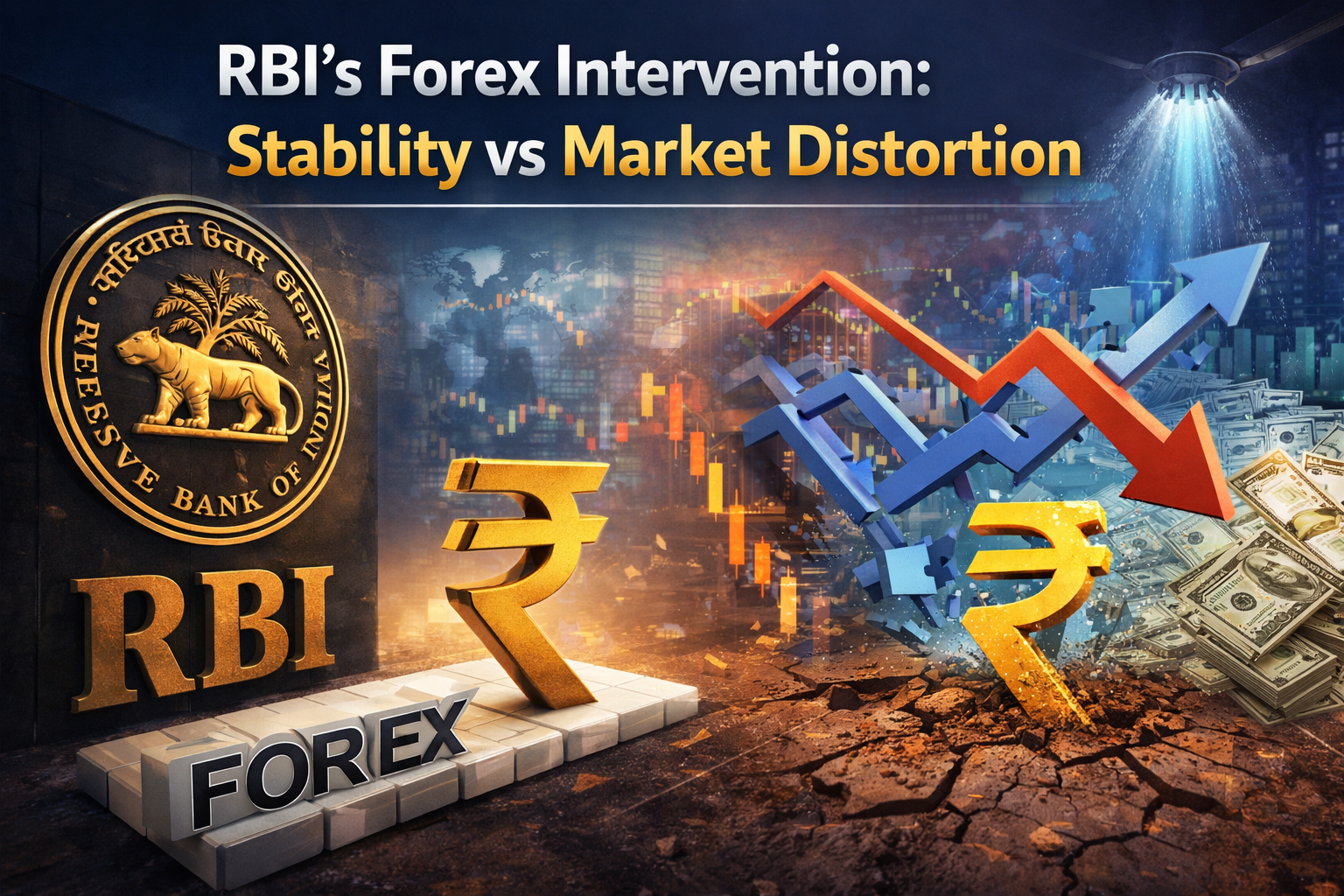
The Reserve Bank of India’s recent move to curb forex arbitrage has sparked an important debate across financial markets.
At a time when the Indian rupee is under pressure, the central bank has chosen to tighten limits on banks’ open currency positions a move aimed at reducing speculative activity and stabilizing the currency.
But the larger question remains:
Is this a sustainable solution or a short-term fix with unintended consequences?
Understanding the Move
The RBI has capped banks’ net open forex positions, effectively forcing them to unwind arbitrage trades between onshore and offshore markets.
These trades had grown significantly as volatility increased and the rupee weakened, creating opportunities to profit from price differences across markets.
By restricting these positions, the RBI is attempting to:
- Reduce speculative pressure
- Improve control over currency movements
- Strengthen the effectiveness of its interventions
Why This Approach Is Being Questioned
While the intent is clear, the execution has raised concerns.
Forced Unwinding Can Disrupt Markets
Banks are now required to quickly exit large arbitrage positions, potentially leading to:
- Sharp market volatility
- Wider spreads between markets
- Losses for financial institutions
In fact, rapid unwinding could trigger disorderly adjustments rather than stability.
Short-Term Stability vs Long-Term Efficiency
Such regulatory caps may provide immediate relief to the rupee.
However, they also:
- Interfere with natural price discovery
- Reduce market liquidity
- Create uncertainty for institutional participants
This raises a critical concern are we stabilizing the currency at the cost of market efficiency?
Underlying Macro Pressures Remain
The rupee’s weakness is not driven by arbitrage alone.
Key structural factors continue to play a role:
- Rising crude oil prices
- Global risk-off sentiment
- Capital outflows from emerging markets
Even with intervention, the RBI itself acknowledges that such actions act more like a “shock absorber” than a permanent solution.
The Bigger Picture: Policy Trade-Offs
Central banks globally often face a difficult balance:
Currency Stability vs Market Freedom
Short-Term Control vs Long-Term Credibility
The RBI’s move reflects a tactical response to immediate pressure—but it also highlights the limitations of intervention in a globally integrated financial system.
What Should Investors Take Away?
This development is not just about forex markets—it signals broader themes:
- Policy actions can create temporary dislocations
- Market-driven mechanisms eventually reassert themselves
- Structural factors ultimately drive currency trends
For investors, the focus should remain on:
- Macro fundamentals
- Currency risk management
- Portfolio diversification
The RBI’s crackdown on forex arbitrage may offer near-term support to the rupee, but its effectiveness could be transient if underlying pressures persist.
In evolving markets, stability is rarely achieved through control alone
it is built on fundamentals, confidence, and balance.