
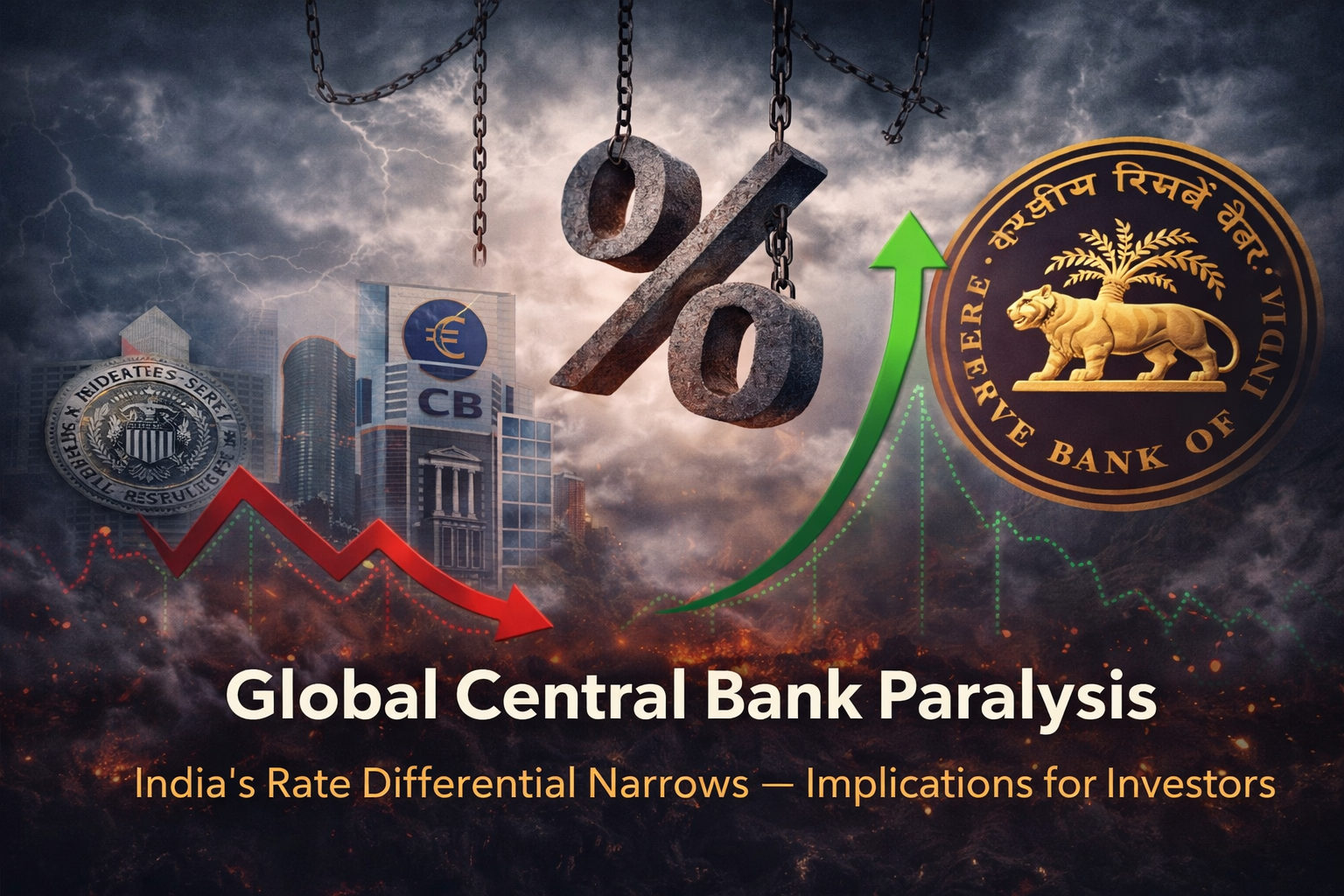
India’s Rate Differential Is Narrowing What It Means for Investors
Global monetary policy is entering an unusual phase.
After an aggressive cycle of rate hikes to combat inflation, major central banks are now showing signs of hesitation rather than direction. The result is a phase that can best be described as policy paralysis where central banks are cautious about both tightening further and easing too soon.
In this backdrop, one key variable for emerging markets like India is beginning to shift
the interest rate differential.
What Is Happening Globally?
Over the past two years, central banks such as the US Federal Reserve, ECB, and others aggressively raised interest rates to control inflation.
Now, inflation has moderated but not fully stabilized. Growth concerns are rising, yet inflation risks remain. This creates a complex situation where:
- Cutting rates too early could reignite inflation
- Holding rates too high could slow growth further
As a result, central banks are largely pausing, waiting for clearer signals.
This pause is not neutral it reflects uncertainty at the highest level of global policy-making.
The Rate Differential
Rate differential refers to the gap between interest rates in India and those in developed markets like the US.
Historically, India has maintained higher interest rates compared to developed economies, which helped:
- Attract foreign capital
- Support currency stability
- Provide a yield advantage to investors
However, this gap is now narrowing.
Is India’s Rate Differential Narrowing?
There are two simultaneous forces at play.
- Elevated Global Interest Rates
Developed economies, especially the US, continue to maintain relatively high interest rates. This keeps global yields attractive and reduces the relative advantage of emerging markets.
- Stable Domestic Policy
India, on the other hand, has adopted a relatively stable and cautious approach. The RBI has avoided aggressive rate hikes recently, focusing instead on balancing growth and inflation.
The result:
The gap between Indian and global interest rates is shrinking.
Why This Matters for India
This shift has important macro and market implications.
- Capital Flow Sensitivity
When the rate differential narrows, the incentive for foreign investors to allocate capital to India reduces. This can lead to:
- Slower foreign inflows
- Increased volatility in equity and debt markets
- Currency Pressure
A lower differential can put pressure on the rupee, as global investors may prefer higher or safer yields elsewhere.
This links directly to:
- Currency stability
- Import costs
- Inflation trends
- Bond Market Dynamics
For fixed income investors, this environment changes the equation:
- Domestic yields may remain range-bound
- Global yields influence local bond markets more strongly
This makes duration and timing decisions more critical.
Is This a Negative Signal?
Not necessarily.
This phase reflects a maturing macro environment, where India is not reacting aggressively but maintaining stability.
However, it does mean that:
- External factors will have a greater influence on domestic markets
- Investors need to be more globally aware than before
What Should Investors Be Thinking?
This is not a phase for reactive decisions it is a phase for strategic alignment.
- Global Context Matters More
Domestic markets cannot be viewed in isolation anymore. Global rates, liquidity, and capital flows will increasingly shape outcomes.
- Currency & Yield Interplay
Understanding how:
- Interest rates
- Currency movement
- Capital flows
interact is essential for better allocation decisions.
- Fixed Income Requires Strategy
In a narrowing differential environment, simply “locking into yields” may not be enough.
Investors need to consider:
- Duration strategy
- Interest rate outlook
- Credit quality
- Diversification Becomes Critical
Exposure across:
- Asset classes
- Geographies
- Strategies
helps mitigate the impact of global policy uncertainty.
The Bigger Picture
The narrowing of India’s rate differential is part of a larger shift:
From a domestic-driven market to a globally interconnected one.
Central bank decisions across the world are now influencing each other more than ever.
This creates a landscape where:
- Policy clarity is limited
- Market reactions are faster
- Volatility can emerge without warning
Periods of policy uncertainty are often misunderstood.
They are not necessarily periods of risk
they are periods of transition.
For investors, the focus should shift from predicting central bank moves to building portfolios that can navigate multiple outcomes.
Because in uncertain cycles, resilience matters more than precision.