
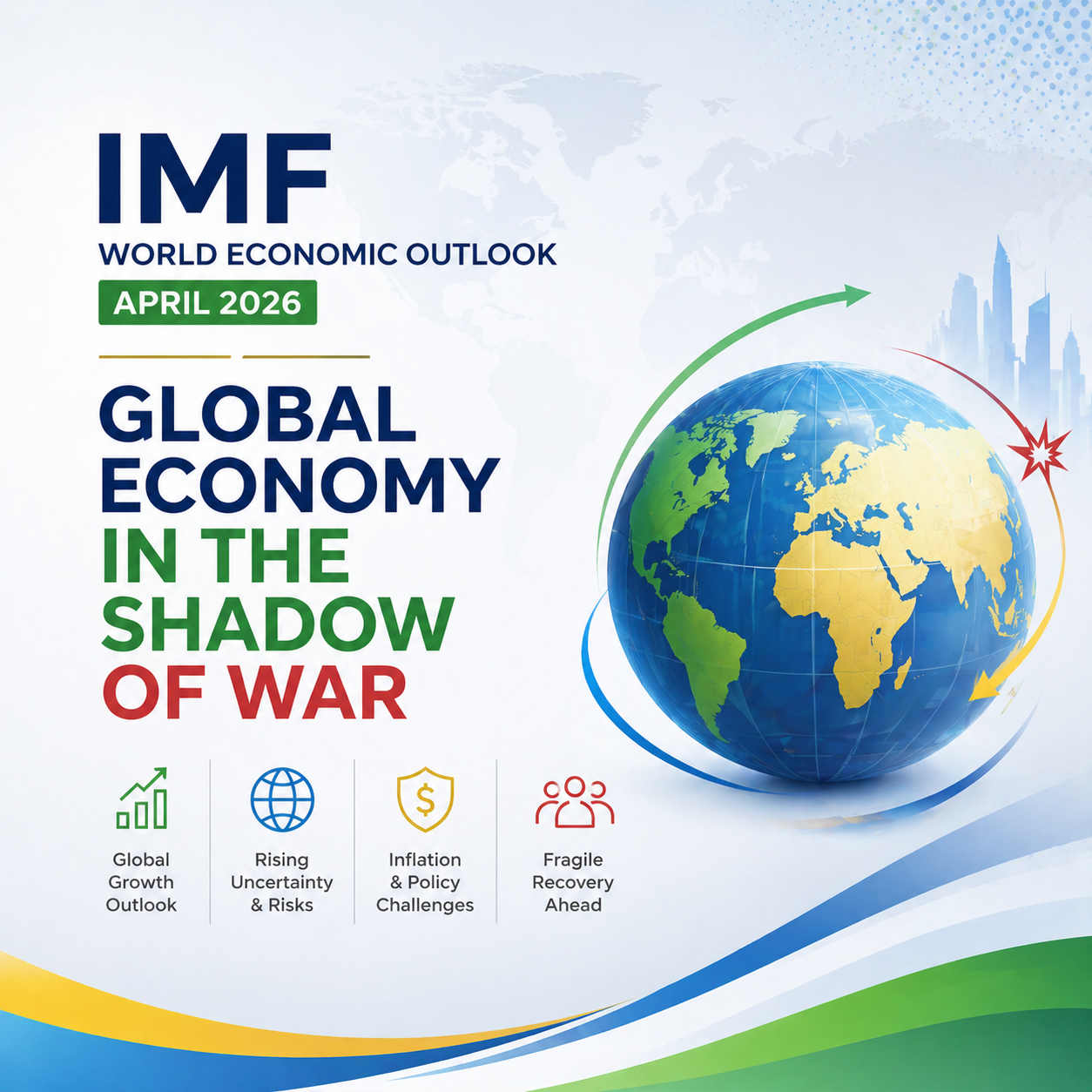
IMF World Economic Outlook April 2026: Global Economy in the Shadow of War
The latest International Monetary Fund World Economic Outlook (April 2026) presents a cautious message for investors, policymakers, and businesses worldwide.
Titled “Global Economy in the Shadow of War,” the report highlights how geopolitical conflict, trade disruptions, inflation risks, and financial uncertainty are reshaping the path of global growth.
At a time when markets were expecting smoother recovery, the IMF reminds us that macroeconomic risks remain elevated.
Why This Report Matters
The IMF World Economic Outlook is one of the most closely followed global macro reports because it influences:
Investor sentiment
Government policy expectations
Central bank outlooks
Currency markets
Commodity trends
Emerging market flows
Its forecasts often shape how institutions position capital globally.
Key Global Themes from the April 2026 Outlook
1. Growth Faces New Headwinds
The global economy continues to expand, but growth momentum is under pressure from:
Geopolitical conflicts
Weak trade flows
Slower industrial demand
High debt levels
Tight financial conditions
This means recovery remains uneven across regions.
2. Inflation Risks Have Not Fully Disappeared
Although inflation has moderated in several economies, risks remain due to:
Energy price shocks
Supply chain disruptions
Food cost volatility
Currency weakness in emerging markets
Central banks may remain cautious longer than markets expect.
3. Markets May Stay Volatile
In uncertain macro environments, markets typically react to:
Rate expectations
Oil price movements
Geopolitical developments
Currency fluctuations
Growth revisions
This can create sharp sector rotation and higher volatility.
What It Means for India
India enters this global phase from a position of relative strength.
India’s Key Supports:
Strong domestic demand
Infrastructure-led growth
Digital economy expansion
Banking sector resilience
Policy continuity
Risks to Watch:
Higher crude oil prices
Export slowdown
Rupee volatility
FII flow swings
India may outperform many peers, but it is not insulated from global shocks What It Means for Investors
For investors, the IMF report reinforces one key principle:
Macro cycles matter—but disciplined asset allocation matters more.
Smart Portfolio Positioning May Include:
Diversification across sectors and assets
Quality businesses with strong balance sheets
Select global exposure
Fixed income for stability
Gold as a hedge during uncertainty
Sector Themes to Watch in 2026
Potentially Resilient:
Financials
Infrastructure
Defence
Domestic consumption
Utilities
More Sensitive:
Export-heavy sectors
Commodity-cost dependent businesses
Highly leveraged companies
Final Insight
The IMF’s April 2026 outlook is a reminder that global growth does not move in a straight line.
War, inflation, and policy uncertainty may slow momentum—but they also create opportunities for disciplined investors who stay focused on long-term fundamentals.
For markets, caution is necessary.
For investors, structure is essential.
For wealth creation, patience remains powerful.
Explore More Insights
To understand how global macro shifts, policy cycles, and disciplined investing shape long-term wealth creation, explore insights from Ranjit Jha, CEO of Rurash Financials, a pioneer in research-driven wealth advisory.
Learn how Rurash Financials empowers investors through:
• AIF access
• Portfolio engineering
• Unlisted equity opportunities
• Personalised wealth strategies
Visit:
https://rurashfin.com/blog/
https://rurashfin.com/media/
https://rurashfin.com/contactus/
https://www.linkedin.com/in/ranjit-mjha/
CTA
Connect with us to structure your portfolio for a changing global economy.