
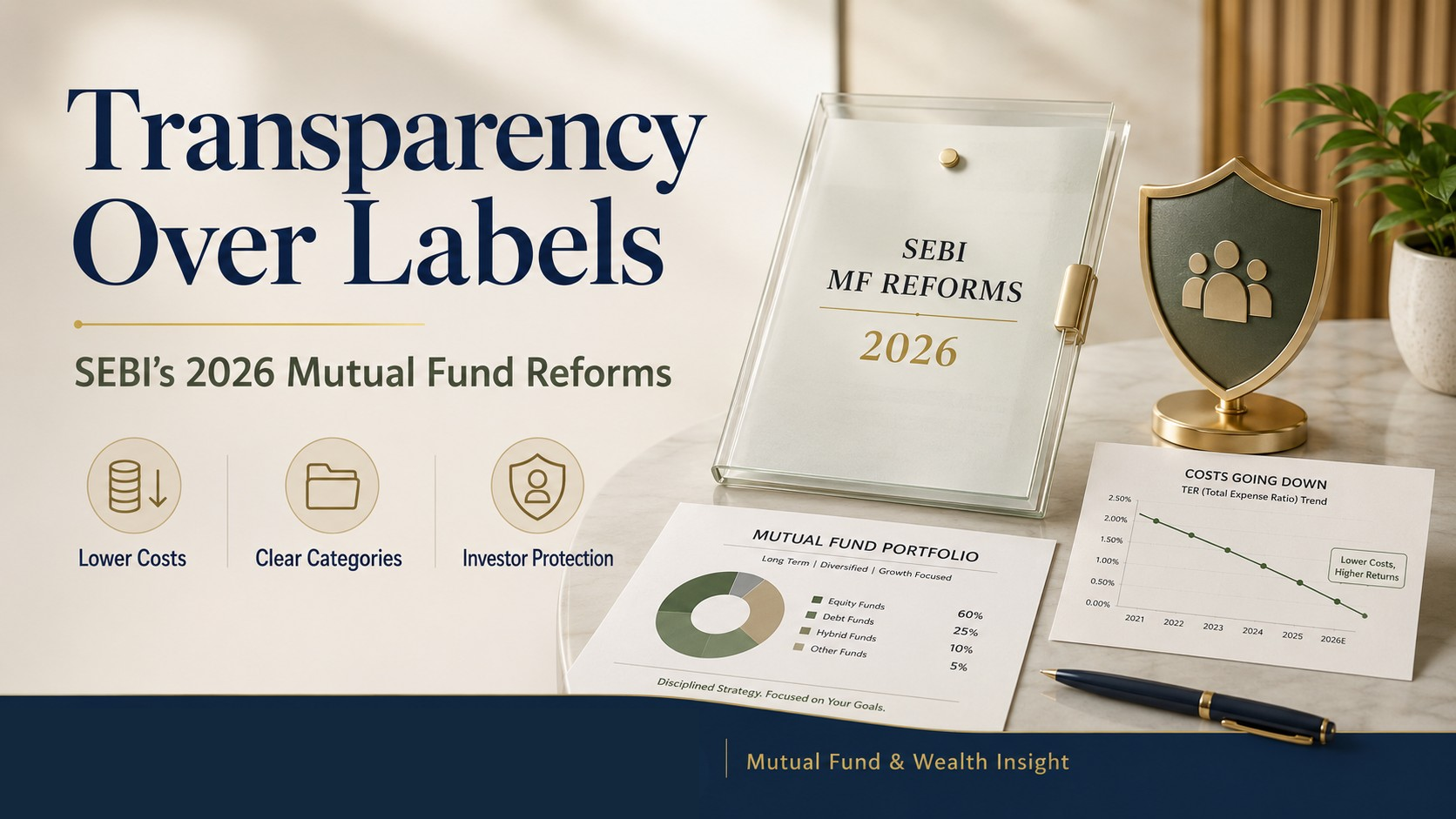
Transparency Over Labels: How SEBI’s 2026 Reforms Protect Your Capital
The Indian mutual fund industry is entering a new era.
For years, investors have been presented with products carrying emotionally appealing labels such as “Retirement Fund,” “Children’s Gift Fund,” or other solution-oriented schemes. While these labels often created a sense of purpose, they did not always guarantee that the underlying portfolio was appropriately structured to meet the investor’s financial objectives.
SEBI’s 2026 reforms aim to change that.
The regulator’s latest directives focus on transparency, scientific asset allocation, and lower investment costs—marking a significant shift from product marketing to investor outcomes.
The message is clear:
Investment success should be driven by portfolio construction, not product labels.
Why SEBI Is Changing the Rules
As India’s investor base continues to expand, regulators are placing greater emphasis on transparency and investor protection.
The traditional approach of marketing funds around life goals often created confusion.
Many investors assumed that purchasing a “retirement” or “children’s” fund automatically guaranteed a suitable investment strategy.
In reality, the effectiveness of any investment depends on:
Asset Allocation
Risk Management
Investment Horizon
Portfolio Rebalancing
Cost Efficiency
SEBI’s reforms seek to align product structures more closely with these fundamental principles.
The End of Solution-Oriented Labels
One of the most significant changes is the removal of broad solution-oriented classifications.
Going forward, fund houses will face stricter requirements before positioning schemes around specific life goals.
Rather than relying on emotional branding, investment products will need to demonstrate how they achieve those objectives through structured portfolio design.
This shift encourages investors to focus on:
Portfolio composition
Risk profile
Investment strategy
Asset allocation methodology
instead of relying solely on marketing narratives.
The Rise of Life-Cycle Investing
At the heart of SEBI’s reforms is the growing emphasis on Life-Cycle Allocation.
This approach recognizes a simple reality:
Investment needs evolve over time.
A young investor may benefit from higher exposure to growth-oriented assets such as equities, while an investor approaching retirement may require greater capital preservation through debt and income-generating instruments.
Under a life-cycle framework:
Early Years
Higher equity allocation for long-term growth.
Mid-Career Stage
Balanced allocation between growth and stability.
Pre-Retirement Phase
Greater focus on capital preservation and income generation.
Retirement Stage
Emphasis on stability, liquidity, and wealth protection.
This structured approach reduces behavioural mistakes and improves alignment between investments and financial goals.
Lower Costs, Better Outcomes
Another major reform focuses on reducing friction costs.
SEBI’s new Base Expense Ratio (BER) framework tightens brokerage transaction limits and encourages greater cost efficiency across the industry.
The expected outcome:
Lower Total Expense Ratios (TERs)
Improved transparency
Better investor returns
Greater alignment between fund managers and investors
While a reduction of 10–20 basis points may appear small, the impact can be substantial over long investment horizons.
Lower costs allow a larger portion of investment returns to remain in the investor’s portfolio.
Why Costs Matter More Than Most Investors Realize
Compounding works in both directions.
Just as investment returns compound over time, investment costs also compound against investors.
Even small reductions in expenses can significantly improve long-term outcomes.
For example:
Lower fees increase net returns.
Higher net returns improve portfolio growth.
Improved growth enhances long-term wealth creation.
This makes cost discipline one of the most powerful yet overlooked factors in investing.
What These Changes Mean for Investors
SEBI’s reforms create several advantages:
Greater Transparency
Investors can better understand what they are buying.
Reduced Misalignment
Product labels become less important than actual portfolio structure.
Better Goal-Based Investing
Life-cycle allocation helps align investments with real-world financial objectives.
Lower Investment Costs
Reduced expenses directly improve long-term returns.
Stronger Investor Protection
Enhanced regulatory oversight improves industry standards.
The Bigger Insight
The future of investing is moving toward evidence-based portfolio construction.
Investors are increasingly recognizing that:
Labels do not create returns.
Marketing does not replace strategy.
Asset allocation drives outcomes.
Costs matter.
Discipline matters.
SEBI’s reforms accelerate this evolution.
The focus is shifting from selling products to buildin portfolios that genuinely support long-term financial goals.
Conclusion
SEBI’s 2026 mutual fund reforms represent a significant step toward a more transparent, investor-centric ecosystem.
By reducing reliance on emotional labels, promoting life-cycle investing, and lowering investment costs, these changes strengthen the foundation of long-term wealth creation.
For investors, the takeaway is simple:
Successful investing is not about choosing the most attractive label. It is about owning the right assets, in the right allocation, at the right cost.
Explore More Insights
To understand how structured portfolios, disciplined asset allocation, and evolving regulations shape long-term wealth creation, explore insights from Ranjit Jha.
Learn how Rurash Financials supports investors through:
Portfolio Engineering
Alternative Investments
Unlisted Equity Opportunities
Personalised Wealth Strategies
Wealth Preservation & Succession Planning
Call to Action
The investment landscape is becoming more transparent, cost-efficient, and investor-focused.
At Rurash Financials, we help investors move beyond product labels and build portfolios aligned with their long-term financial goals.
Connect with Rurash Financials to create a structured investment strategy designed for sustainable wealth creation.