
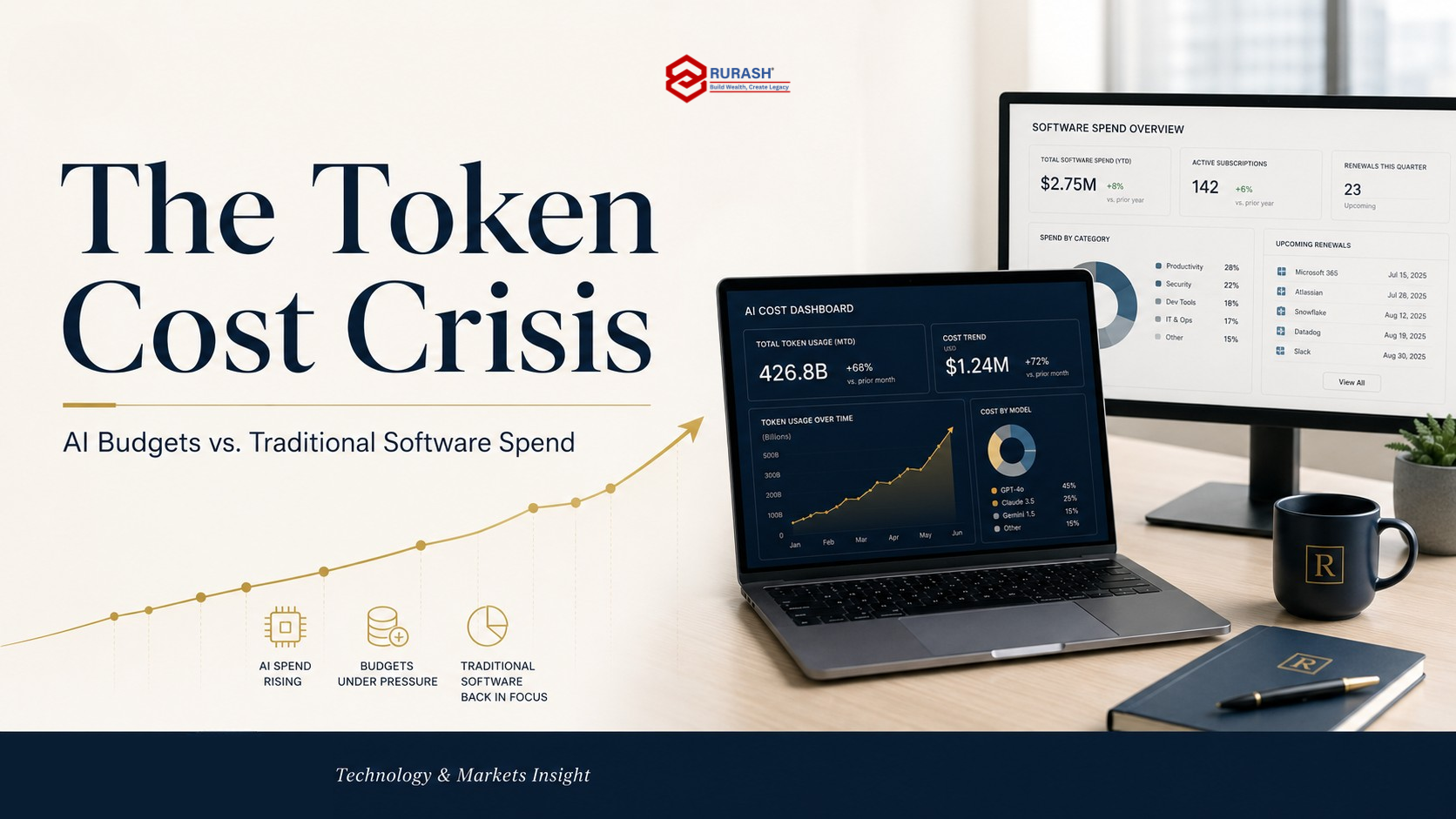
The Token Cost Crisis: How Exploding AI Budgets Revived Traditional Software Spend
Artificial Intelligence has become one of the most transformative technologies of the decade. Companies across industries are integrating AI into workflows, customer experiences, research processes, and operational decision-making.
However, as adoption moves from experimentation to enterprise-wide deployment, a new challenge has emerged: cost.
What initially appeared to be a revolutionary productivity tool is now forcing businesses to confront rapidly expanding AI budgets. The result is an unexpected shift—many organizations are rediscovering the value of traditional software solutions.
The market is beginning to realize that while AI offers powerful capabilities, not every business problem requires an expensive AI-driven answer.
Understanding the Token Economy
Most modern AI models operate on a token-based pricing structure.
Every prompt, query, document upload, API request, and generated response consumes tokens. As usage scales across departments and workflows, token consumption rises significantly.
For enterprises deploying AI across thousands of employees, these costs can quickly become substantial.
What begins as a pilot project often evolves into a recurring operational expense that is far larger than initially anticipated.
Why AI Budgets Are Expanding Rapidly
Several factors are contributing to the rise in enterprise AI spending.
Increased Usage Volumes
As employees adopt AI tools more frequently, token consumption grows exponentially.
Organizations are moving from hundreds of daily requests to millions.
Enterprise-Wide Deployments
Companies are integrating AI into:
Customer support
Sales operations
Software development
Research functions
Internal knowledge systems
This significantly increases infrastructure and usage costs.
Premium AI Models
Many enterprises prefer advanced AI models for higher accuracy and better performance.
These premium models often come with significantly higher pricing structures.
Data Processing Requirements
Beyond token costs, businesses also face expenses related to:
Data storage
Cloud infrastructure
Security controls
Compliance requirements
System integration
The total cost of AI ownership extends well beyond API usage.
The Return of Traditional Software
As AI budgets rise, CFOs and technology leaders are asking a fundamental question:
Does every workflow require AI?
In many cases, traditional software can solve business challenges more efficiently and at a lower cost.
Tasks involving:
Workflow automation
Data management
Reporting
Document processing
Standard customer interactions
can often be handled effectively through conventional software platforms.
AI vs Software: The Emerging Balance
The market is moving toward a more balanced technology strategy.
Instead of replacing traditional software entirely, organizations are increasingly combining:
Traditional software for predictable workflows
AI for complex decision-making
Automation tools for repetitive tasks
This hybrid approach helps optimize both performance and cost.
What This Means for Technology Companies
The shift has important implications across the technology sector.
AI Providers
AI companies must demonstrate measurable business value that justifies rising costs.
Pricing efficiency is becoming as important as innovation.
Software Companies
Traditional software vendors are finding new opportunities.
Businesses are reassessing existing platforms and extending software investments that continue to deliver strong ROI.
System Integrators
Organizations increasingly need guidance on determining where AI creates value and where traditional solutions remain sufficient.
This is creating new demand for consulting and implementation expertise.
Implications for India
India’s technology ecosystem stands at an interesting intersection of this trend.
The country hosts:
Global IT service providers
Software development firms
AI consulting businesses
Enterprise technology specialists
As companies seek cost-efficient digital transformation strategies, Indian technology firms may benefit from helping clients optimize technology spending.
The focus is shifting from AI adoption at any cost to AI adoption with measurable outcomes.
Investor Perspective
Investors should view this trend as a sign of market maturity rather than weakness.
The next phase of AI adoption will likely be driven by:
Cost efficiency
Practical implementation
Business outcomes
Sustainable ROI
This creates opportunities across:
Enterprise software companies
IT services firms
AI infrastructure providers
System integrators
Digital transformation specialists
The winners may not simply be those building AI, but those enabling cost-effective deployment.
The Bigger Insight
Every technology revolution eventually faces an economic reality check.
The internet experienced it.
Cloud computing experienced it.
Artificial Intelligence is now experiencing it.
The conversation is shifting from:
“Can we use AI?”
to
“Where does AI create enough value to justify the cost?”
That distinction will define the next phase of enterprise technology spending.
Conclusion
The Token Cost Crisis is reshaping how organizations think about technology investments.
While AI remains a powerful force for innovation, rising costs are encouraging businesses to adopt a more balanced approach.
Rather than replacing traditional software, AI is helping redefine where software, automation, and intelligence each deliver the greatest value.
The future is unlikely to be AI versus traditional software.
It is more likely to be AI working alongside traditional software in a carefully optimized technology ecosystem.
Explore More Insights
To understand how technology disruption, market trends, and structured portfolios shape long-term wealth creation, explore insights from Ranjit Jha.Learn how Rurash Financials supports investors through:
Portfolio Engineering
Alternative Investments
Unlisted Equity Opportunities
Personalised Wealth Strategies
Wealth Preservation & Succession Planning
Call to Action
Technology cycles create both disruption and opportunity.
At Rurash Financials, we help investors identify emerging themes, evaluate long-term opportunities, and build portfolios aligned with future growth trends.
Connect with Rurash Financials to explore investment opportunities emerging from the evolving technology and AI ecosystem.