
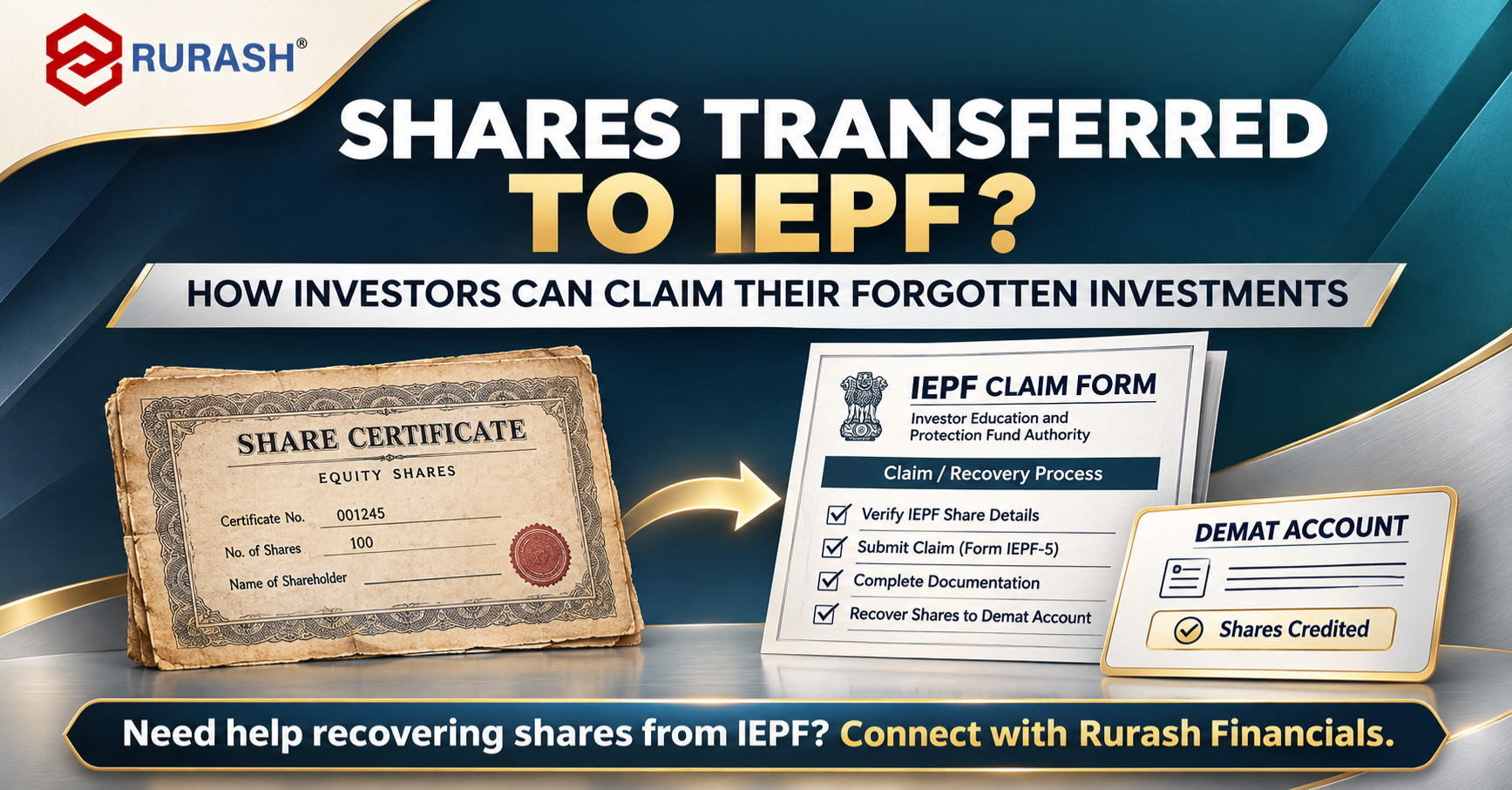
Hero insight: Your shares may have moved to IEPF. Does that mean you’ve lost them forever?
Imagine discovering that shares purchased by your father twenty or thirty years ago are no longer reflected in the family’s investment records.
The original share certificates may still be stored in a cupboard. Dividend payments may have stopped arriving years ago. The shareholder’s registered address or bank account may no longer be active.
When the family contacts the company, they discover that the shares have been transferred to the Investor Education and Protection Fund (IEPF).
For many investors, this creates an immediate concern: Have these investments been permanently lost?
The important answer is that eligible shares transferred to IEPF can be claimed through the prescribed recovery process, subject to ownership verification and documentation.
However, recovering these investments requires understanding why the transfer occurred, identifying the correct shareholder records and completing the formal claim procedure.
For long-term shareholders, senior citizens, Non-Resident Indians (NRIs) and legal heirs, knowing the IEPF share recovery process can be an important part of protecting and organising family wealth.
What Is IEPF and Why Are Shares Transferred to It?
The Investor Education and Protection Fund is a statutory fund established under the Companies Act, 2013.
It is administered by the IEPF Authority under the Ministry of Corporate Affairs.
The framework covers certain unpaid or unclaimed amounts, including dividends, and shares meeting the prescribed transfer conditions.
Under Section 124 of the Companies Act, unpaid or unclaimed dividends remaining in a company’s Unpaid Dividend Account for seven years must be transferred to IEPF.
A separate provision requires the transfer of shares where dividends have not been paid or claimed for seven consecutive years or more, subject to applicable exceptions.
Importantly, where a dividend is paid or claimed during that consecutive seven-year period, the statutory shares-transfer condition is not met merely because some other dividends remain unclaimed.
This distinction matters because unclaimed dividends and transferred shares are related but separate records that investors should verify.
Does Transfer to IEPF Mean the Shares Are Lost Forever?
No. A transfer to IEPF does not, by itself, extinguish an eligible shareholder’s ability to seek recovery.
The Companies Act provides a mechanism through which an entitled claimant may request the return of transferred shares.
The prescribed process involves submitting Form IEPF-5, establishing ownership or legal entitlement, and completing verification through the relevant company and the IEPF Authority.
If the claim is approved, eligible shares may be credited to the claimant’s demat account, while approved monetary claims are processed through the applicable electronic-payment mechanism.
However, successful recovery is not automatic.
The claimant must demonstrate entitlement, provide accurate information and satisfy the applicable documentation requirements.
1. How Can Investors Check Whether Their Shares Are With IEPF?
Before filing a claim, the first step is to establish the current status of the investment.
An investor should identify the company, original shareholder, folio number and available shareholding details.
Check the company’s investor-relations website
Companies commonly publish information concerning unpaid dividends, IEPF transfers and shareholder services.
Look for sections such as Unclaimed Dividend, IEPF, Shareholder Information or Investor Services.
The available information may help establish whether dividends or shares have been transferred to IEPF.
Contact the Registrar and Transfer Agent
The company’s Registrar and Transfer Agent (RTA) maintains important shareholder records.
Investors can approach the current RTA to request information about the relevant folio, shareholding history and transfer status.
Where a company has changed its name, merged or undergone restructuring, historical records may require additional reconciliation.
Review official IEPF information
The IEPF Authority website provides information about claims and the applicable filing process.
Investors should rely on verified company and government sources rather than unknown intermediaries promising guaranteed recovery.
Investor takeaway: Confirm whether the shares are actually with IEPF before beginning the claim process.
2. Which Documents Are Required for IEPF Share Recovery?
Documentation is one of the most important parts of the recovery process.
The exact documents depend on the shareholder’s status, type of holding, identity records and whether the claim involves original shareholders or legal heirs.
Document or information | Why it matters |
|---|---|
PAN card | Verifies the claimant’s identity |
Aadhaar or applicable identity documents | Supports prescribed identity and payment verification |
Demat account details and Client Master List | Identifies the account for share credit |
Original folio number | Helps trace historical ownership |
Physical share certificates, where relevant | Supports verification of historical holdings |
Bank account evidence | Supports verification and monetary-claim processing |
Form IEPF-5 acknowledgement | Records the submitted claim |
Indemnity or other prescribed declarations | Supports applicable claim requirements |
Marriage certificate or name-change documents | Helps explain variations in shareholder details |
Death certificate and succession-related documents | May establish entitlement in a deceased shareholder’s case |
Company or RTA correspondence | Helps reconcile records and track deficiencies |
The IEPF Authority’s instruction kit identifies form requirements, including valid PAN details, supporting attachments and checks relating to existing claims for the same folio or demat account.
Not every claimant requires every document in this table.
Investors should first identify their claim category and obtain the applicable document requirements from the official instructions and the company’s nodal officer.
3. IEPF Share Recovery Process: Step-by-Step Guide
How an IEPF claim progresses
Identify the investment
Confirm the company, folio or demat details, share quantity and available records of transfer to IEPF.
Prepare supporting documents
Reconcile the claimant’s PAN, name, bank details, demat account and ownership or succession documents.
Submit Form IEPF-5
File the prescribed claim electronically through the MCA portal and retain the acknowledgement and Service Request Number (SRN).
Complete company verification
Submit or dispatch applicable supporting documents to the company’s designated nodal officer according to the current procedure, and complete the required dispatch details.
IEPF Authority review
The company submits its electronic verification report; the Authority examines the claim and may approve it or request clarification or resubmission.
Receive approved entitlements
On approval, shares are transferred to the eligible claimant’s demat account and approved monetary claims are processed through the prescribed payment mechanism.
Based on the official IEPF-5 instruction kit and MCA V3 filing guidance. Requirements may vary according to the claim.
Step 1: Identify the company and shares
Before submitting any form, confirm the registered company name, folio details, original holding and the nature of the claim.
The number of shares may have changed over time due to bonus issues, stock splits, mergers or other corporate actions.
Investors should reconcile these events where relevant rather than relying solely on the quantity printed on an old certificate.
Step 2: Ensure the demat account is ready
Share recovery generally requires a valid demat account to receive the approved securities.
The claimant should check that the account details, PAN and holder information are consistent with the claim.
A mismatch between the application and the demat Client Master List can create additional verification questions.
Step 3: File Form IEPF-5
The claimant must provide the required information through the prescribed webform.
This can include details of the company, shareholder, securities, unpaid amounts and applicable supporting records.
The information should be checked carefully before submission.
Step 4: Complete the company’s verification requirements
Submitting the online claim does not necessarily complete the entire process.
The company’s nodal officer plays an important role in verifying the shareholder’s entitlement and supporting records.
Under MCA’s V3 procedure, the claimant may also be required to provide dispatch information relating to documents sent to the company.
The company submits its electronic verification report through the applicable process.
Step 5: Track and respond to any deficiencies
The IEPF Authority may seek corrections, additional documents or clarification.
Claimants should monitor their registered email and the official application-status facility.
Where a resubmission is required, the claimant should follow the instructions carefully and retain acknowledgements.
Step 6: Receive the approved shares
Once the claim is approved and the prescribed procedures are completed, the eligible shares can be credited electronically.
The investor should verify the actual share credit and any monetary refund rather than treating the application acknowledgement as proof of successful recovery.
4. Why Do IEPF Claims Sometimes Get Delayed?
Even where the underlying share entitlement is genuine, a claim may require additional verification.
Common difficulties include the following.
Name and signature mismatches
Older shareholder records may use initials, maiden names or signatures that differ from current documents.
For example, an original certificate may record R. K. Mehta, while the current PAN uses the full name Ramesh Kumar Mehta.
Such differences can require supporting documents and verification.
Incorrect folio or demat details
A wrong folio number, PAN or demat account identifier can prevent records from matching.
Investors should cross-check the available information before filing.
Missing original documents
In some cases, the investor may not have the original physical certificates or historical ownership records.
The applicable procedure may then require additional documentation.
Incomplete legal-heir documentation
Where the registered shareholder has died, the claimant must establish their legal entitlement.
Missing succession-related records or unresolved differences among claimants can delay verification.
Company restructuring
If the original company merged, changed its name or underwent corporate restructuring, historical shareholder information may need additional reconciliation.
Unresolved requests for clarification
A claim may remain incomplete if requested information is not supplied within the applicable period.
Official claim guidance specifically addresses incomplete documentation, resubmissions and the company’s verification responsibilities.
The practical lesson is simple: Organising the documents before submitting the application can help reduce avoidable delays.
5. Can Legal Heirs Recover Shares Transferred to IEPF?
Yes, eligible legal heirs, successors, nominees or administrators may be able to pursue recovery, subject to the applicable succession and verification requirements.
For example, consider a family that discovers old investment records after a shareholder’s death.
The family may find that the investments were transferred to IEPF years earlier.
The deceased shareholder cannot personally submit the claim, so the eligible claimant must establish entitlement through the applicable legal and documentary process.
Depending on the circumstances, documents may include a death certificate, nominee-related records, succession documents, declarations or other required evidence.
The IEPF rules provide specific procedures for legal heirs and other eligible successors, including the company’s responsibility to verify the claimant’s entitlement.
An important distinction is that being a family member does not automatically establish legal entitlement to claim the securities.
The applicable succession and ownership requirements must be satisfied.
6. What Should Senior Citizens and NRIs Check?
Senior citizens may face practical difficulties when old records are incomplete, signatures have changed or historical correspondence is unavailable.
A careful review of identity documents, registered folio information and banking records can help identify potential discrepancies.
For NRIs, additional considerations may arise from overseas addresses, identity documentation, demat-account eligibility and applicable banking or regulatory requirements.
The correct process depends on the shareholder’s residential status, account structure and nature of the investment.
NRIs should not assume that a claim requires exactly the same documentation as a resident investor.
Where necessary, the claimant should clarify the appropriate verification requirements with the company, RTA, depository participant and relevant professionals.
7. Are Unclaimed Dividends Recovered Through the Same Claim?
Where both shares and dividends have been transferred to IEPF, the eligible claimant may seek the relevant entitlements under the prescribed claim procedure.
However, dividend recovery and share recovery should be reconciled separately.
The investor should identify the financial years for which dividends were declared, the amounts remaining unpaid and whether those amounts were transferred to IEPF.
An investor may discover that some unpaid dividends still remain with the company while older amounts have already moved to IEPF.
The appropriate recovery route depends on the current status of each entitlement.
This is why obtaining a complete history from the company or RTA is useful.
8. How Long Does the IEPF Recovery Process Take?
The claim process includes several stages, and the total time can vary.
The company must examine the documents and provide its verification report within the applicable regulatory timeframe.
The IEPF rules provide for the Authority to dispose of a complete and duly verified claim within 60 days of receiving the company’s verification report, with reasons required to be recorded for delays beyond the specified period.
However, this is not a promise that every claim will be completed within 60 days of the investor filing Form IEPF-5.
Additional document requests, ownership verification, incomplete records and resubmissions may extend the overall process.
Investors should distinguish between a prescribed processing period and a guaranteed recovery date.
9. A Practical Example: Forgotten Family Shares
Consider a hypothetical investor who purchased 500 physical shares of a listed company many years ago.
Over time, the shareholder stopped receiving communications and did not claim dividends for several consecutive years.
The shares were subsequently transferred to IEPF under the applicable rules.
Years later, the investor’s family discovers the old investment records.
The correct approach is to establish the company’s present identity, reconcile corporate actions, identify the current share entitlement and check whether the original shareholder is alive.
If the shareholder is alive, the claim can be evaluated through the applicable shareholder procedure.
If the shareholder has died, an eligible claimant must first establish the appropriate legal entitlement.
In both situations, the application must be supported by the required records.
The example illustrates that recovery begins with understanding the investment history, not simply submitting a form.
10. IEPF Share Recovery Checklist
Before starting a claim, investors should answer these questions:
Have the company and original shareholder been correctly identified?
Are the folio number and shareholding records available?
Has the transfer to IEPF been confirmed?
Have any relevant corporate actions been reconciled?
Is the claimant’s demat account active and suitable for receiving shares?
Do the PAN, name and other identity records match?
Are the required supporting documents complete?
Does the claim involve a deceased shareholder or a legal heir?
Has the current company’s nodal officer been identified?
Is there a system for tracking the claim, acknowledgements and resubmissions?
These checks can help investors prepare a more organised application and understand which issues need to be resolved.
The Bigger Picture: Forgotten Investments Are Part of Family Wealth Planning
Investments can remain overlooked for several reasons.
Older shareholders may have moved homes, changed contact details or lost track of financial records.
Corporate actions and changes in company names can make securities harder to recognise.
Family members may also be unaware of investments held by parents or grandparents.
For long-term shareholders and their families, maintaining a consolidated inventory of investments, folio details, demat accounts and nominee information can support better financial recordkeeping.
IEPF share recovery is therefore not only about an individual claim.
It is also a reminder of the importance of maintaining accurate ownership records and communicating essential financial information within families.
Ranjit Jha’s Perspective — Draft for Approval
Proposed editorial perspective for Ranjit M. Jha, MD & CEO, Rurash Financials. Approval required before attribution.
Many long-term investments represent wealth built by families over several decades.
When shareholder records become outdated or dividends remain unclaimed, investors may lose track of investments that continue to have financial significance.
A transfer to IEPF should prompt investors to understand the prescribed recovery process rather than assume that the underlying entitlement has permanently disappeared.
However, successful recovery depends on accurate documentation, ownership verification and compliance with the applicable procedures.
A structured review of legacy investments can help families identify unresolved holdings and take informed steps towards reclaiming eligible entitlements.
Explore More with Rurash
At Rurash Financials, we understand that recovering shares transferred to IEPF can involve historical records, shareholder verification and detailed documentation.
For long-term investors, senior citizens, NRIs and legal heirs, identifying the appropriate claim procedure can be an important first step.
Through our IEPF Recovery and Dematerialisation-related services, Rurash assists investors in understanding the documentation process, reviewing legacy shareholding information and navigating applicable recovery requirements.
Your shares may have moved to IEPF. Your next step is to understand how to claim them.
Need help recovering shares from IEPF? Connect with Rurash Financials.