
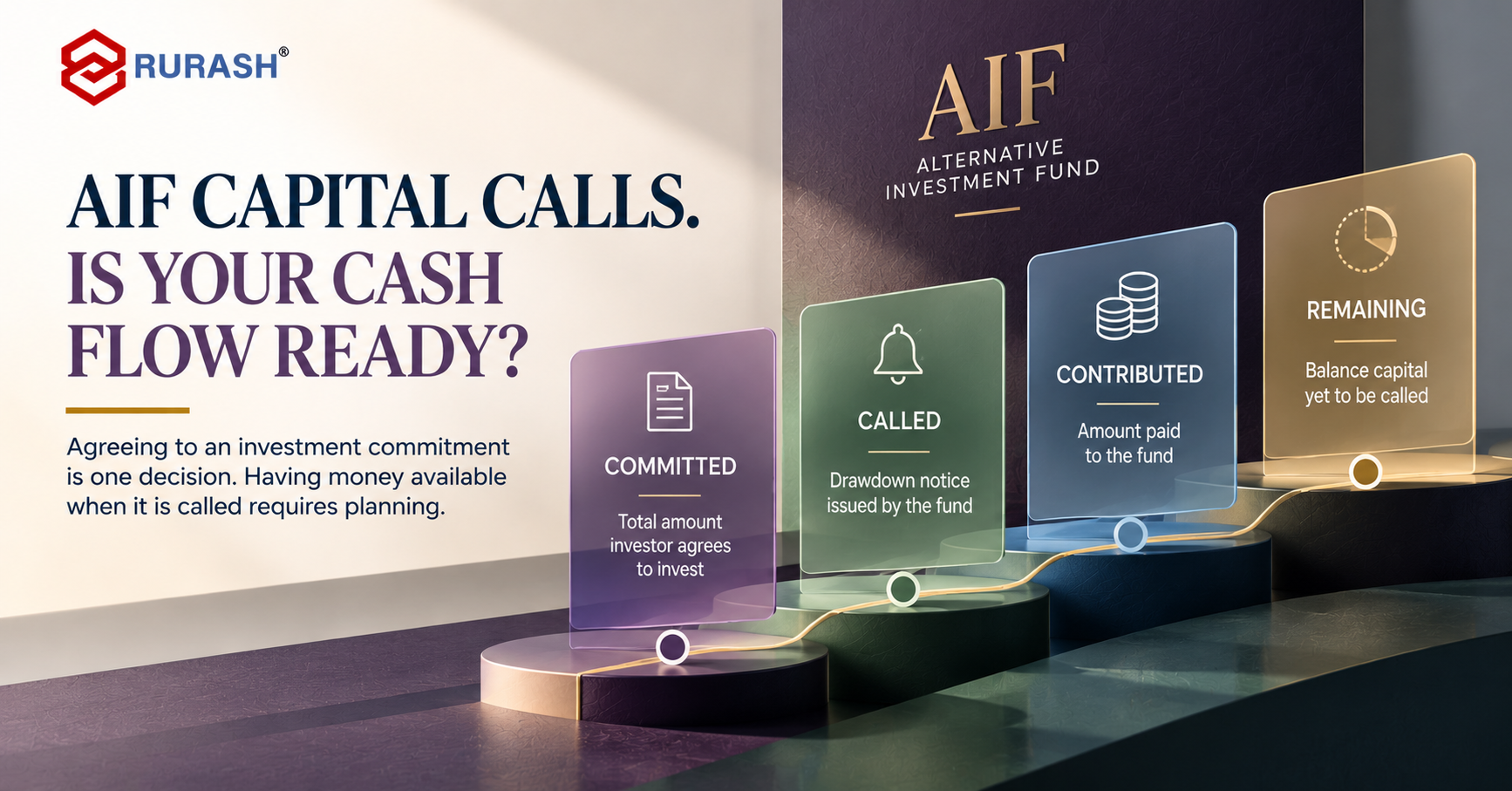
Hero insight: Agreeing to an investment commitment is one decision. Having money available when it is called requires planning.
Alternative Investment Funds (AIFs) offer eligible investors access to specialised investment strategies, including private equity, venture capital, private credit and other alternative investment opportunities.
For High-Net-Worth Individuals (HNIs), business owners and experienced investors, AIFs can form part of a broader investment portfolio.
However, investing in an AIF may involve a financial obligation that differs from making a one-time investment in a mutual fund.
In certain AIF structures, investors agree to commit a specified amount of capital, but the fund may collect that amount gradually through capital calls or drawdowns.
This means an investor could commit ₹1 crore today without contributing the entire amount immediately.
The remaining amount may be requested later, according to the fund’s governing documents.
The important question is not only how much you can commit, but whether your cash flow can support future funding obligations.
What Are AIF Capital Calls?
An AIF capital call is a request by the fund manager for an investor to contribute a portion of the capital previously committed to the fund.
Rather than collecting all commitments upfront, certain funds draw capital as investment opportunities or other permitted funding requirements arise.
For example, a private-equity AIF may identify suitable businesses over an investment period and request capital when funding is needed.
This approach allows the fund to deploy capital according to its investment strategy.
However, it also means investors must maintain adequate liquidity to meet future drawdown requests.
The capital-call process is generally governed by the fund’s Private Placement Memorandum (PPM), contribution agreement and other applicable documents.
The precise terms differ across funds.
1. Committed Capital vs Contributed Capital: What Is the Difference?
Understanding these two terms is essential.
Committed capital is the total amount an investor has contractually agreed to provide to the AIF.
Contributed capital is the amount the investor has actually paid into the fund.
The difference represents the remaining unfunded commitment, subject to the agreement and relevant adjustments.
Consider a hypothetical investor committing ₹1 crore to an AIF.
ILLUSTRATIVE AIF CAPITAL COMMITMENT
₹1 crore
Total committed capital
Already contributed
₹40 lakh
Remaining commitment
₹60 lakh
Hypothetical illustration. Actual drawdowns depend on the terms of the relevant AIF.
The ₹60 lakh remaining commitment is not necessarily an amount immediately payable.
However, it represents a potential future obligation that the investor must be prepared to fund under the agreement.
This distinction matters when planning liquidity, business expenses and other investments.
2. How Does an AIF Drawdown Notice Work?
When the fund requires capital, it generally issues a drawdown notice to relevant investors.
The notice may specify the amount due, payment deadline, bank details and other instructions.
A typical capital-call process involves the following stages:
Investment commitment: The investor agrees to the contractual contribution amount.
Funding requirement: The manager determines the capital required under the fund’s terms.
Drawdown notice: The investor receives a formal payment request.
Capital contribution: The investor transfers the amount within the applicable deadline.
Updated records: The fund records the contribution against the investor’s commitment.
The notice period should not be assumed to be identical across all AIFs.
Some schemes may provide a defined number of business days, while others may operate under different contractual arrangements.
Investors should check the required notice period and payment procedure before making a commitment.
A capital call is generally the funding of an existing contractual commitment, not a new investment decision each time a notice arrives.
3. Why Capital Calls Can Create Cash Flow Pressure
An investor may have sufficient wealth to make a large AIF commitment without holding the equivalent amount in immediately accessible funds.
For example, a business owner may have substantial assets invested in equities, real estate, unlisted securities and business interests.
However, these assets may not be readily convertible into cash.
If an AIF issues a drawdown notice while the business is experiencing temporary cash-flow pressure, meeting the payment deadline could become difficult.
This is especially relevant when capital calls occur alongside tax obligations, working-capital requirements or family commitments.
Therefore, investors should distinguish between net worth and available liquidity.
Being financially capable of investing ₹1 crore is not necessarily the same as being able to fund ₹25 lakh at short notice.
4. What Happens When Multiple AIFs Issue Capital Calls?
Investors allocating to several AIFs may face overlapping funding obligations.
Consider a hypothetical investor with commitments across three funds.
AIF | Remaining commitment | Illustrative amount called |
|---|---|---|
Private Equity AIF | ₹40 lakh | ₹15 lakh |
Private Credit AIF | ₹30 lakh | ₹10 lakh |
Venture Capital AIF | ₹50 lakh | ₹20 lakh |
Total | ₹1.20 crore | ₹45 lakh |
Illustrative figures only. These are not actual fund commitments or forecasts.
If the three drawdown notices arrive around the same time, the investor may need ₹45 lakh within the applicable payment periods.
Even if the investor expected calls to occur gradually, their timing could overlap.
This illustrates why investors should review unfunded commitments across the entire alternative investment portfolio.
Cash-flow planning should account for a scenario in which several funds request contributions within a relatively short period.
5. What Happens If You Miss an AIF Capital Call?
Failing to meet a drawdown obligation may have financial and contractual consequences.
However, there is no single penalty structure that applies identically to every AIF.
Depending on the fund’s governing documents and applicable law, consequences may include default interest or charges, restrictions on investor rights, dilution, compulsory transfer, forfeiture provisions or other remedies.
Not all funds apply these measures, and their availability and enforceability depend on the specific agreement and applicable requirements.
Before investing, ask the fund manager:
What happens if a contribution is delayed?
Is there a contractual grace period?
Are default interest or other charges applicable?
Could ownership rights or economic interests be affected?
What procedures apply before a default remedy is exercised?
These are important questions because a temporary personal liquidity problem could lead to a more serious investment consequence.
6. Can You Use Existing Investments to Meet a Capital Call?
An investor may consider maintaining cash reserves, redeeming liquid investments or arranging funds from other available financial resources.
However, each option has different risks.
Selling market-linked investments during a correction can crystallise losses.
Redeeming another investment may trigger taxes, exit charges or other consequences.
Borrowing against assets may introduce interest expenses, collateral requirements and repayment obligations.
Investors should not assume that AIF distributions will arrive in time to fund later calls from the same fund or another investment.
A more sustainable approach is to plan for capital calls using financial resources that can be made available without disrupting essential obligations.
7. How Should Investors Prepare for Future Drawdowns?
Liquidity planning begins before the AIF contribution agreement is signed.
Investors should evaluate their total outstanding commitments and consider how these obligations fit alongside expected income, business expenses and planned withdrawals.
A practical approach is to create a capital-commitment calendar identifying the remaining amount for each fund, any disclosed expected drawdown periods and the relevant contractual payment terms.
Because drawdown timing can be uncertain, the schedule should be treated as a planning tool rather than a guaranteed payment timetable.
An investor may also consider maintaining an appropriate liquidity reserve based on personal circumstances.
The objective is not necessarily to keep every rupee of the unfunded commitment idle in cash at all times.
It is to establish a credible funding plan that can accommodate contractual deadlines and unexpected timing overlaps.
8. Can the Manager Call Capital for Expenses?
Depending on the scheme’s structure and documents, capital calls may fund investments and certain permitted fund expenses.
This makes the definition of capital commitment particularly important.
Investors should understand whether contributions can be used for management fees, setup costs, operating expenses or other specified purposes.
The PPM and contribution agreement should explain the relevant arrangements.
SEBI’s AIF Master Circular provides a framework for disclosures through the PPM, including detailed illustrations of fees, charges and distribution waterfalls.
The actual use of drawn capital must be assessed against the fund’s governing terms.
9. Why Capital Calls and AIF Exit Planning Are Connected
Capital calls concern when money enters the fund.
Exit planning concerns when money may return to the investor.
Both influence liquidity.
A fund may draw capital over several years while its underlying investments remain illiquid for longer.
Expected distributions may be delayed, and a fund’s reported valuation does not mean an equivalent amount is immediately available in cash.
Investors should therefore assess the full capital-flow lifecycle:
Commitment → Drawdowns → Investment holding period → Realisation → Distributions
A suitable AIF commitment should account for uncertainty at each stage.
AIF Capital Calls: Investor Checklist
Before committing capital to an AIF, review these questions:
What is my total capital commitment?
How much must be contributed initially?
How much will remain unfunded?
What notice period applies to future drawdowns?
Can several capital calls occur close together?
Can contributions be required for permitted fund expenses?
What happens if I miss a payment deadline?
What fees or other consequences may follow a default?
Do my business and household cash flows support the obligation?
Can I remain invested without depending on early distributions?
Investors should seek written clarification where fund documents are unclear.
Ranjit Jha’s Perspective — Draft for Approval
Proposed editorial perspective for Ranjit Jha, MD & CEO, Rurash Wealth Management. Approval required before attribution.
Alternative Investment Funds can provide access to specialised investment opportunities, but investors should understand the obligations that accompany a capital commitment.
The ability to commit capital is only one part of the decision. Equally important is having sufficient liquidity when the fund requests contributions.
Investors holding multiple AIFs should pay particular attention to overlapping capital calls, business cash-flow requirements and other financial responsibilities.
A structured alternative-investment allocation should consider both the investment opportunity and the investor’s capacity to meet future obligations throughout the fund’s lifecycle.
Explore More with Rurash
At Rurash Wealth Management,we believe evaluating an AIF should involve more than reviewing the investment strategy and potential returns.
Capital commitments, drawdown requirements, liquidity and exit conditions should all be considered before investing.
For HNIs, business owners and eligible investors exploring Alternative Investment Funds, understanding how each fund’s structure fits their financial circumstances is essential.
Rurash helps investors explore AIF opportunities while considering portfolio suitability, capital commitments and long-term financial requirements.
Before committing capital, make sure your cash flow is prepared.
Connect with Rurash Wealth Management to discuss AIF structures and your investment requirements.