
PMS Fees Explained: What to Check Before Choosing a Portfolio Manager
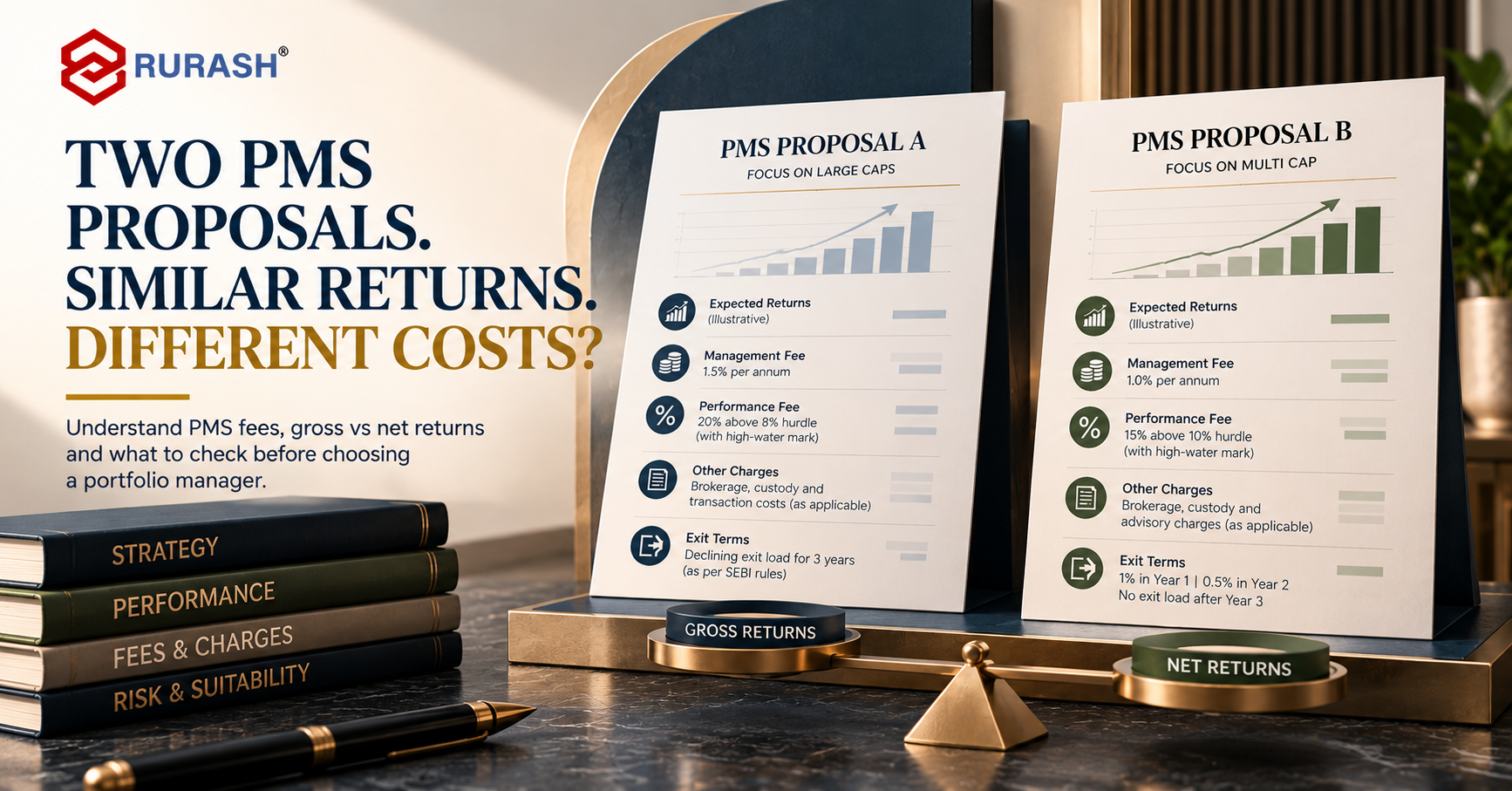
Hero insight: Two PMS proposals may show similar returns. But are you comparing the same thing?
Portfolio Management Services (PMS) have become an important investment option for eligible investors seeking professionally managed portfolios and more focused investment strategies.
For High-Net-Worth Individuals (HNIs) and experienced investors, choosing a Portfolio Management Service involves evaluating the fund manager’s investment philosophy, historical performance, risk-management approach and portfolio construction.
However, one important factor can sometimes receive less attention than it deserves: the complete cost of investing.
Two PMS providers may present similar historical returns, yet the actual returns received by investors can differ because of management fees, performance-linked charges, transaction expenses and exit conditions.
A strategy reporting attractive gross returns may deliver a different outcome after all applicable costs.
This raises an important question:
Are you comparing the performance of two PMS strategies, or are you comparing what investors actually earn after expenses?
Understanding PMS fees is an essential part of making an informed portfolio management decision.
What Are PMS Fees and Why Do They Matter?
Portfolio Management Services involve professional management of an investor’s portfolio under an agreed investment mandate.
Unlike a conventional mutual fund structure, where investors own units of a pooled investment scheme, PMS clients typically hold securities in portfolios managed according to the applicable arrangement.
The portfolio manager may charge fees for investment management, along with other expenses specified in the client agreement.
SEBI’s Portfolio Managers Regulations and Master Circular provide a regulatory framework covering fee disclosures, agreements, performance reporting and investor protection.
Master Circular for Portfolio Managers+1
For investors, the relevant question is not whether fees exist.
It is whether those charges are transparent, reasonable in relation to the services provided and appropriately assessed alongside investment performance and risk.
1. Gross Returns vs Net Returns: What Is the Difference?
One of the first checks when comparing PMS performance is understanding whether the reported returns are gross or net of fees.
Gross Returns
Gross returns generally represent investment performance before deducting specified fees and expenses.
They can help investors understand the performance generated by the investment strategy.
However, gross returns do not necessarily represent the return the client receives.
Net Returns
Net returns reflect performance after the deductions included in the stated reporting methodology.
These may include management fees, performance-related charges and other applicable costs.
Investors should verify precisely which expenses are included in the net-return calculation.
For example, consider a hypothetical PMS portfolio with an initial value of ₹50 lakh.
Assume it generates a 12% gross investment return over one year.
ILLUSTRATIVE PMS RETURN COMPARISON
Gross portfolio return
12%
Simplified net return
10%
Starting portfolio: ₹50 lakh. Gross gain: ₹6 lakh. Illustrative total fees and expenses: ₹1 lakh. Remaining gain: ₹5 lakh.
Hypothetical illustration only. Actual net returns depend on the timing and method of fee calculation, cash flows, transaction costs and other expenses. Taxation is not included.
The difference between gross and net performance becomes particularly important when evaluating results over several years.
Investor takeaway: Always compare PMS returns using consistent reporting periods and fee treatment.
2. Understand the Management Fee Structure
A management fee is charged for providing professional portfolio management services.
PMS providers may offer fixed-fee arrangements, performance-linked arrangements or combinations of the two, subject to the terms agreed with the client.
Fixed Management Fees
Under a fixed-fee arrangement, the investor pays an agreed management fee, often expressed as a percentage of assets under management.
The fee calculation and payment frequency should be specified in the agreement.
A fixed fee may apply even when investment performance is negative.
For example, a hypothetical annual fee of 1.5% on an unchanged ₹50 lakh asset base would amount to ₹75,000 before any other applicable charges.
The actual calculation can differ when asset values change or the agreement uses periodic valuation dates.
Variable or Performance-Linked Fees
Some PMS providers charge fees linked to portfolio performance.
These arrangements may involve a hurdle rate, a performance-fee percentage and high-water-mark calculations.
The key is understanding how the manager determines the amount on which the performance fee is payable.
Investor takeaway: A lower fixed management fee does not automatically mean a lower total cost when performance-linked charges are also involved.
3. What Is a Performance Fee in PMS?
A performance fee is linked to investment performance as defined under the PMS agreement.
It may be charged when the portfolio achieves specified performance conditions.
For example, a contract may include a hurdle rate and a percentage fee on eligible gains above the applicable threshold.
However, fee structures can differ across managers.
The investor should confirm whether the hurdle is simple or compounded, how cash additions and withdrawals are treated and how the performance-fee calculation interacts with the high-water-mark principle.
What Is the High-Water-Mark Principle?
A high-water mark helps ensure that performance-related fees are charged on eligible gains above a previously achieved portfolio-value level, rather than repeatedly charging for recovery of earlier losses.
SEBI’s PMS fee framework incorporates the high-water-mark principle for calculating performance-related fees.
Consider a simplified example:
An investor starts with ₹50 lakh.
The portfolio rises to ₹60 lakh in Year 1.
It declines to ₹54 lakh in Year 2.
It recovers to ₹60 lakh in Year 3.
Assuming no contributions, withdrawals or other adjustments, and a previous fee-assessment high-water mark of ₹60 lakh, merely recovering to ₹60 lakh in Year 3 would not create a new gain above that high-water mark.
The actual charge depends on the agreement’s performance-fee formula and the treatment of relevant adjustments.
Investor takeaway: Ask the portfolio manager for a worked performance-fee example covering both positive and negative market periods.
4. What Is a Hurdle Rate?
A hurdle rate is a specified performance threshold used in certain performance-linked fee arrangements.
For example, an agreement may specify an 8% annual hurdle.
But that does not necessarily mean every PMS provider using an 8% hurdle calculates fees identically.
Investors should clarify whether the hurdle is calculated annually, compounded or applied according to another contractual method.
They should also ask whether the fee is assessed only on gains above the hurdle or using a different formula permitted under the agreement.
A hurdle rate should not be confused with an assured or guaranteed investment return.
An 8% hurdle is a fee-calculation feature, not a promise that the portfolio will deliver 8% returns.
5. Other PMS Charges Investors Should Review
Management and performance fees are not necessarily the only costs.
Depending on the arrangement, investors may incur brokerage, custody expenses, transaction-related charges, statutory levies and other permissible costs.
These can affect overall investment performance.
For example, a strategy involving frequent buying and selling may generate greater transaction costs than a strategy with relatively low portfolio turnover.
Investors should understand which charges are included in the management fee and which are billed separately.
SEBI’s framework requires relevant fee and charge disclosures to be provided through the PMS client agreement and associated documentation.
The objective should be to calculate the total economic cost rather than comparing only the headline fee percentage.
6. What Are Exit Loads in PMS?
Exit loads are charges that may apply when an investor withdraws money or exits an arrangement within a specified period.
Under the generally applicable SEBI framework for PMS clients, exit loads are subject to a declining maximum structure during the first three years, with no exit load after that period.
Special provisions apply to certain categories of clients, including large-value accredited investors, for whom contractual arrangements can differ.
Investors should review the exact exit-load schedule in the applicable agreement.
Questions to ask include whether the charge applies to partial withdrawals, how the holding period is calculated and whether other costs may arise when securities are sold or transferred.
An investor may need liquidity for a business requirement, family obligation or significant financial purchase.
Exit terms can therefore affect the suitability of a PMS even when the historical return record appears attractive.
7. Why Two PMS Proposals With Similar Returns May Not Be Comparable
Consider two hypothetical PMS strategies.
Both present a historical gross return of 15% over a comparable period.
However, one may operate with a fixed management fee, while the other uses a combination of fixed and performance-linked fees.
Their total costs can differ depending on the portfolio’s performance, the fee-calculation periods and the applicable expenses.
But there is another issue.
The strategies may also have different investment universes, portfolio concentration, cash positions and risk characteristics.
One may primarily hold established large-cap businesses, while another may invest in a more concentrated selection of mid-cap companies.
Even if both report similar returns, investors may be taking materially different risks.
A meaningful PMS comparison must evaluate returns, expenses, strategy and risk together.
8. Compare PMS Performance Using a Consistent Framework
When reviewing a PMS proposal, investors should examine performance over multiple market conditions rather than focusing only on one strong period.
Historical results should be considered alongside the selected benchmark, reporting methodology, portfolio risk and strategy changes.
Investors should also confirm whether the advertised performance represents the investment approach or an individual client’s realised experience.
Actual client outcomes may differ because of investment timing, contributions, withdrawals, fees and portfolio implementation.
A relevant comparison should examine how consistently the manager has followed the stated investment philosophy and how the strategy has behaved during periods of market decline.
Short-term outperformance alone should not determine the selection.
9. What Documents Should You Read Before Choosing a PMS?
Before signing a PMS agreement, investors should review the disclosure document, client agreement, fee schedule and investment-approach details.
SEBI’s framework also provides for fee illustrations across different portfolio-performance scenarios and fee-calculation tools to help investors assess costs.
These disclosures can be particularly useful when comparing fixed and performance-linked arrangements.
Investors should request clarification wherever charges or terms are unclear.
The aim is to understand not only what the service may cost in a favourable year, but also what it could cost during flat or negative market conditions.
PMS Evaluation Checklist: Ten Questions to Ask
Before selecting a Portfolio Management Service, review these points:
Are the displayed returns gross or net of fees?
What is the fixed management fee, and how is it calculated?
Is there a performance-linked fee?
How are the hurdle rate and high-water mark applied?
Which transaction and operating expenses are charged separately?
What are the exit conditions and applicable charges?
How does historical performance compare with the relevant benchmark?
What concentration and investment risks does the strategy involve?
Are the fee illustrations and contractual documents clearly explained?
Does the overall PMS arrangement match the investor’s financial goals and liquidity needs?
These questions can help investors move beyond a simple comparison of reported returns.
Is the Lowest-Fee PMS Always the Best Choice?
Not necessarily.
Lower fees can improve net returns when other factors are comparable.
However, portfolio management quality, investment discipline, risk management and suitability also matter.
A low-cost strategy may still be unsuitable if it involves risks that the investor cannot comfortably tolerate.
Similarly, higher fees are not justified merely because a manager has delivered strong historical returns.
The relevant question is whether the investor understands the total cost and considers it appropriate for the investment strategy and services provided.
A PMS should be assessed by the combination of net outcomes, risk, transparency and suitability.
Ranjit Jha’s Perspective — Draft for Approval
Proposed editorial perspective for Ranjit Jha, MD & CEO, Rurash Wealth Management. Approval required before attribution.
Choosing a Portfolio Management Service requires more than comparing historical return figures.
Investors should understand the difference between gross and net performance, the fee structure and the risks associated with each investment strategy.
Management fees, performance-linked charges and exit terms can influence the investor’s actual financial outcome.
A thoughtful PMS evaluation should consider whether the manager’s approach, portfolio construction and total costs are aligned with the investor’s objectives, liquidity requirements and capacity to manage risk.
Explore More with Rurash
At Rurash Wealth Management, we believe selecting a Portfolio Management Service should begin with a clear understanding of investment strategy, risk and costs.
For HNIs and eligible investors evaluating PMS opportunities, comparing portfolio managers requires more than reviewing headline performance.
Rurash helps investors explore PMS solutions and assess factors such as investment approach, fund-manager selection, fee structures, liquidity and portfolio suitability.
Two PMS proposals. Similar returns. Have you compared the total costs?
Connect with Rurash Wealth Management to discuss PMS evaluation.