
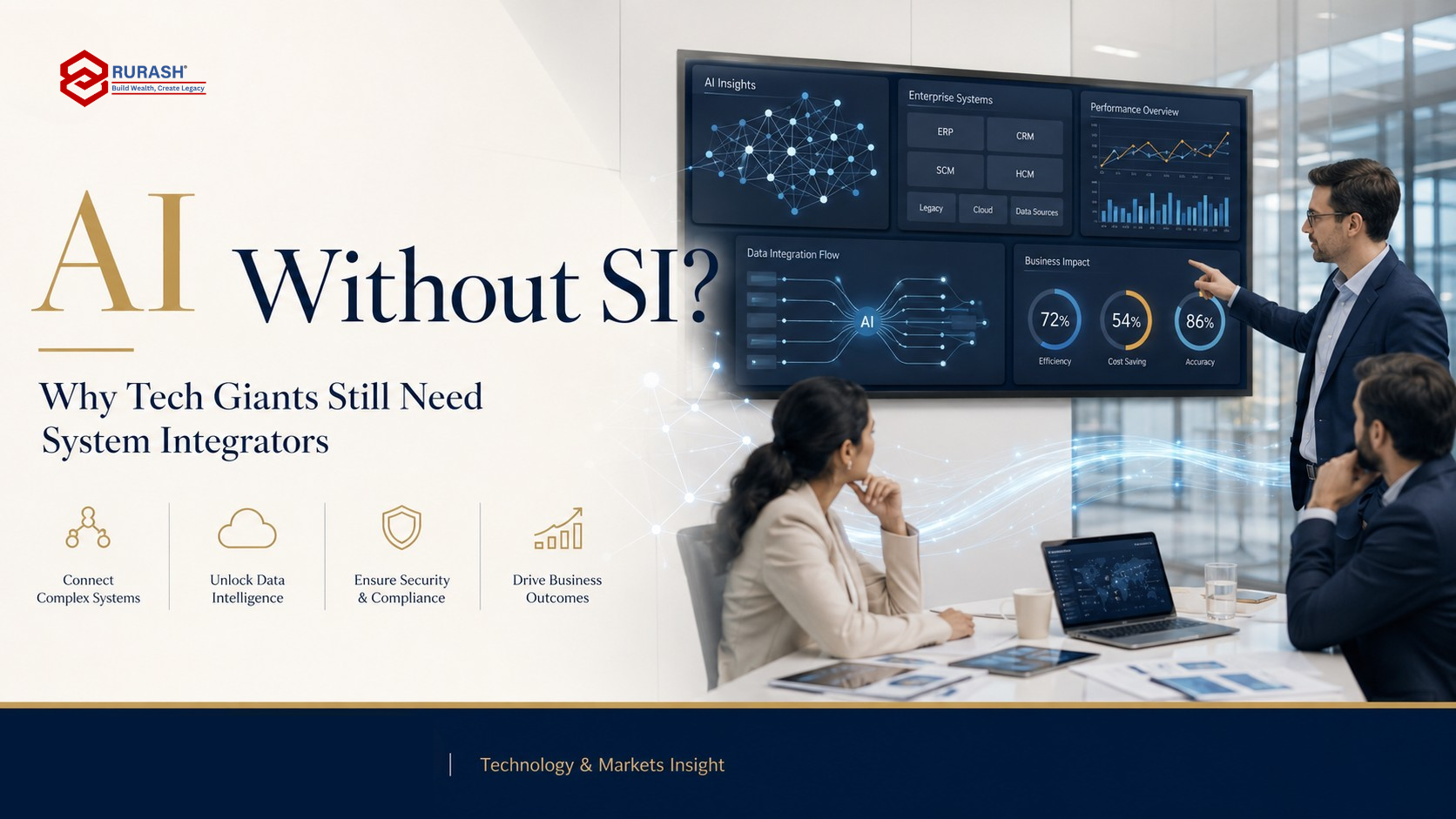
AI Without SI? How the Markets Realized Tech Giants Still Need System Integrators
For much of the past two years, the artificial intelligence narrative has revolved around one question:
Who will build the most powerful AI models?
Investors poured capital into technology giants developing cutting-edge AI capabilities, from large language models to advanced enterprise solutions. The assumption was straightforward: superior AI technology would naturally translate into business value.
However, as enterprises moved from experimentation to implementation, a different reality emerged.
AI may be the engine, but system integrators (SIs) are the bridge that connects innovation to execution.
The market is beginning to recognize that AI adoption at scale requires more than powerful algorithms. It requires integration, customization, governance, security, and operational alignment.
In short, AI without system integrators remains incomplete.
The Early AI Investment Thesis
The first phase of the AI boom focused heavily on infrastructure and model development.
Investors rewarded companies involved in:
AI chips and computing infrastructure
Foundation models
Cloud platforms
Data centers
AI software tools
This created substantial value for technology leaders building the foundational layers of the AI ecosystem.
Yet enterprises quickly discovered that deploying AI across complex organizations was far more challenging than expected.
The Missing Piece: Enterprise Integration
Most organizations operate across multiple systems, departments, databases, and workflows.
Introducing AI into this environment requires:
Data integration
Process redesign
Cloud migration
Cybersecurity frameworks
Regulatory compliance
Employee adoption and training
This is where system integrators play a critical role.
They help organizations translate AI capabilities into measurable business outcomes.
Without effective integration, even the most advanced AI models struggle to deliver enterprise-wide value.
Why System Integrators Are Back in Focus
The market’s attention is increasingly shifting toward firms capable of executing large-scale digital transformation projects.
Several factors are driving this trend.
Enterprise Complexity
Large organizations rarely operate on a single technology platform.
AI must interact seamlessly with:
ERP systems
CRM platforms
Legacy infrastructure
Data warehouses
Cloud environments
System integrators possess the expertise required to connect these environments.
AI Governance Requirements
As AI adoption expands, governance becomes increasingly important.
Organizations need frameworks for:
Data privacy
Risk management
Model monitoring
Regulatory compliance
System integrators help build these safeguards while ensuring operational continuity.
Customization Matters
No two enterprises are identical.
AI solutions often require:
Industry-specific adaptation
Workflow customization
Proprietary data integration
Sector-focused use cases
System integrators act as the architects who tailor AI solutions to specific business requirements.
What This Means for Technology Companies
The realization that AI adoption requires implementation expertise is changing market dynamics.
Technology providers increasingly rely on ecosystem partners to scale enterprise deployments.
This creates a collaborative model where:
AI companies provide innovation
Cloud providers offer infrastructure
System integrators enable execution
Rather than replacing system integrators, AI is creating new opportunities for them.
Implications for India
India occupies a unique position within the global AI ecosystem.
The country is home to some of the world’s largest IT services and system integration firms.
As global enterprises accelerate AI adoption, Indian technology firms are well-positioned to benefit through:
AI consulting services
Enterprise transformation projects
Managed services
Cloud modernization
Industry-specific AI deployment
This could create a significant growth opportunity for India’s technology services sector.
Investor Perspective
For investors, the AI story is evolving.
The opportunity is no longer limited to companies building AI.
Value creation is increasingly occurring across the broader ecosystem.
Investors should monitor:
AI infrastructure providers
Cloud platforms
Cybersecurity firms
Data management companies
System integrators and IT services firms
The winners may not only be those creating AI, but also those enabling its widespread adoption.
The Bigger Insight
Technology revolutions often follow a predictable pattern.
The first wave rewards innovators.
The second wave rewards enablers.
AI appears to be entering that second phase.
As organizations move from experimentation to deployment, execution capability becomes just as important as technological capability.
This is where system integrators become indispensable.
Conclusion
The AI revolution is no longer just about building smarter models.
It is about embedding intelligence into real-world businesses.
While technology giants continue to drive innovation, system integrators remain essential for turning AI potential into operational reality.
Markets are beginning to recognize a simple truth:
AI may transform industries, but transformation still requires integration.
Explore More Insights
To understand how technology trends, market shifts, and emerging opportunities influence long-term wealth creation, explore insights from Ranjit Jha and the Rurash Financials research team.
Learn how Rurash Financials supports investors through:
Portfolio engineering
Alternative investments
Unlisted equity opportunities
Personalized wealth strategies
Call to Action
Connect with Rurash Financials to stay informed about emerging investment themes shaping the future of technology, markets, and wealth creation.