
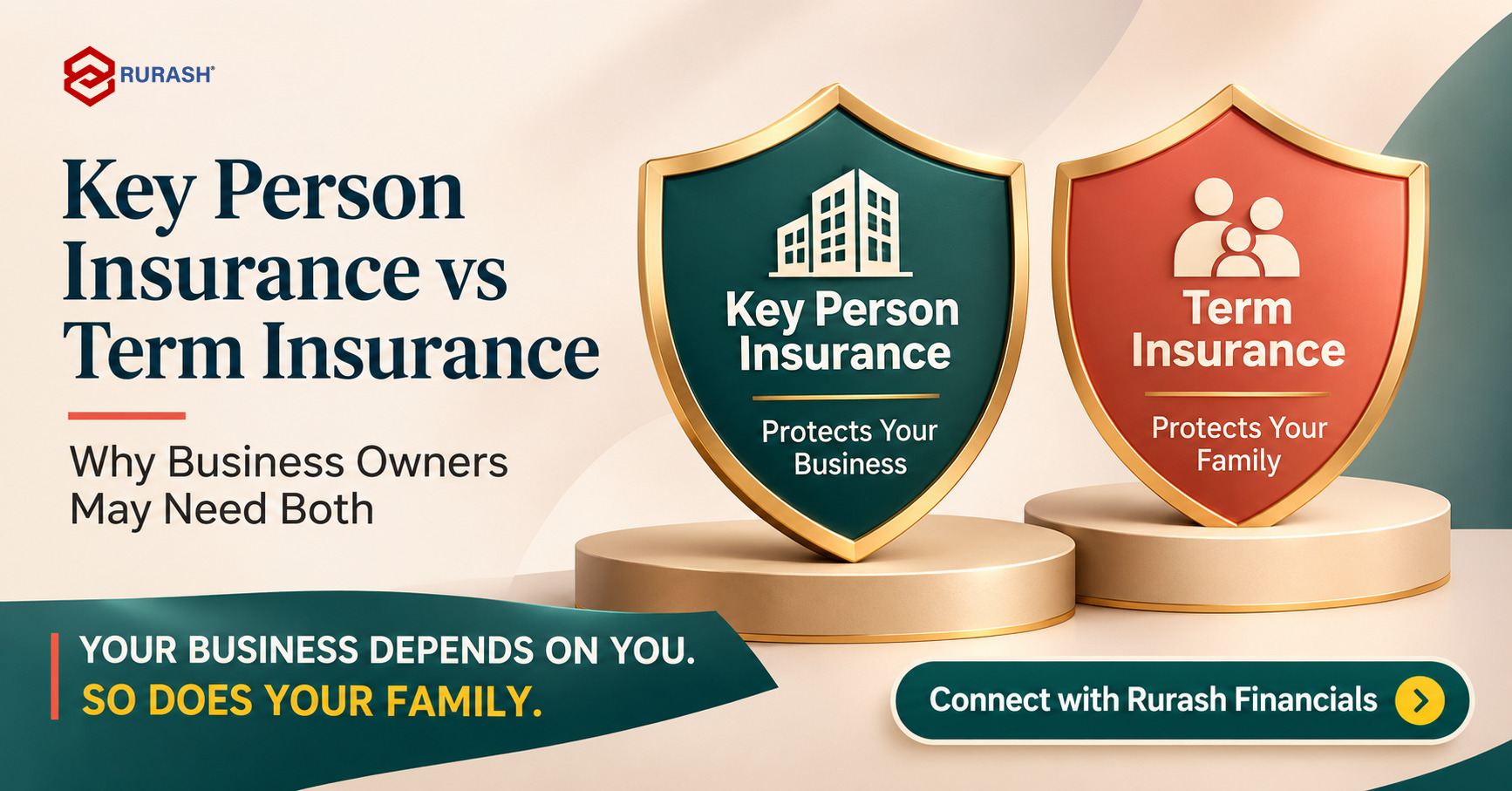
Hero insight: Your family depends on you. Your business may depend on you too. Are both financially protected?
For many entrepreneurs, business ownership and personal financial responsibilities are closely connected.
A founder may manage important customer relationships, oversee daily operations, negotiate financing arrangements and lead the company’s long-term strategy. At the same time, the founder’s income may support household expenses, children’s education, loan repayments and family financial goals.
But what happens if that individual unexpectedly passes away?
The family may face the loss of an important income source. The business may experience operational disruption, reduced revenue, uncertainty among customers and additional costs associated with replacing key leadership.
These are two different financial exposures.
Term insurance primarily protects the financial interests of a person’s dependants, while Key Person Insurance is intended to protect a business against the financial consequences of losing someone critical to its operations.
For business owners, understanding the distinction can help establish a more comprehensive protection strategy.
Why Is Insurance Planning Different for Business Owners?
A salaried professional may primarily focus on protecting dependants against the loss of personal income.
A business owner often has another responsibility: maintaining the financial stability of an enterprise.
Consider a manufacturing business where the founder personally manages major supplier relationships and financing arrangements.
If the founder dies unexpectedly, the family may need money to meet household expenses and outstanding personal obligations.
Meanwhile, the business may need funds to retain employees, appoint new leadership, manage working capital and maintain commercial relationships.
A personal life insurance payout may support the family, but it does not automatically provide capital to the company.
Similarly, an insurance policy owned by the business may support business continuity without directly providing financial protection to the founder’s family.
This is why the two requirements should be evaluated separately.
1. What Is Key Person Insurance?
Key Person Insurance, often called Keyman Insurance, is a life insurance arrangement taken by a business on the life of an individual whose contribution is important to the organisation.
Depending on eligibility and policy terms, this individual may be a founder, director, senior executive, technical specialist or employee responsible for significant business revenue.
The business generally purchases the policy, pays the premiums and is entitled to the benefit under the arrangement.
Its purpose is to provide financial support if the insured key person dies during the coverage period.
Such funds may help the business manage operating disruption, recruitment expenses, revenue pressure or other financial consequences.
India’s tax framework recognises Keyman Insurance as insurance covering a person connected with the policyholder’s business, subject to the statutory definition.
Key Person Insurance protects a business interest. It is not intended to replace an individual’s personal family-protection arrangements.
2. What Is Term Insurance?
Term insurance is a form of life insurance that generally provides death-benefit protection for a specified policy period.
Under a conventional personal term insurance arrangement, the policyholder chooses a sum assured and policy term, subject to insurer underwriting.
If the insured person dies during the covered period and the claim meets the policy conditions, the insurer pays the death benefit to the entitled recipient.
The payout may help the family manage household expenses, outstanding liabilities, education requirements and longer-term financial needs.
Traditional pure term insurance generally does not provide a maturity payout when the insured survives the policy term.
Other product variants may have different features and costs.
For a business owner, personal term insurance is particularly important when the household depends on income generated through the business.
3. Key Person Insurance vs Term Insurance: What Is the Difference?
Factor | Key Person Insurance | Personal Term Insurance |
|---|---|---|
Primary purpose | Business continuity and financial protection | Family financial protection |
Typical policyholder | Business entity | Individual |
Insured person | Eligible key individual | Individual whose life is covered |
Premium payer | Generally the business | Generally the individual |
Benefit recipient | Generally the business | Entitled nominee or beneficiary |
Financial exposure addressed | Loss of critical business contribution | Loss of personal income or family support |
Cover assessment | Business dependency and financial exposure | Income, liabilities and family needs |
Tax considerations | Business-related tax treatment applies | Personal life insurance provisions apply |
General comparison. Actual policy ownership, benefits, eligibility, underwriting and taxation depend on the product and contractual arrangement.
The most important distinction is who needs the financial protection and who is entitled to receive the insurance proceeds.
4. How Does Key Person Insurance Help a Business?
A business may depend heavily on the expertise, reputation or commercial relationships of a limited number of individuals.
For example, a specialised engineering company may rely on its technical director to oversee critical projects.
If that person unexpectedly dies, the company may require additional funds to maintain operations while identifying a replacement.
A Key Person policy can provide financial support, subject to the insured event and policy conditions.
It may help the business address temporary revenue disruption, recruitment and training expenses, outstanding financial commitments or a transition in leadership.
However, the presence of insurance does not guarantee that customers will remain, operations will continue uninterrupted or all business losses will be covered.
It is a financial risk-management tool, not a substitute for operational continuity planning.
5. Why Term Insurance Remains Important for Founders
Entrepreneurs sometimes assume that because their business has substantial value, their family’s long-term financial position is already secure.
However, business valuation and immediately available household liquidity are different.
A founder may own shares in a successful private company but have limited personal cash reserves.
The company may also carry financial obligations or require continued investment to operate.
If the founder dies, family members may not be able to convert the ownership stake into cash immediately.
Personal term insurance can help address this gap by providing a death benefit under the policy’s terms.
A valuable business does not automatically mean a financially protected family.
6. A Practical Example: One Founder, Two Financial Needs
Consider a hypothetical entrepreneur who owns a growing manufacturing company.
The business relies on the founder for major customer relationships, strategic decisions and financing discussions.
The founder also supports a spouse, two children and dependent parents.
One unexpected event. Two different protection needs.
Business protection
Key Person Insurance may help provide funds for operating continuity, leadership replacement and financial disruption.
Family protection
Personal term insurance may help dependants manage household needs, liabilities and future financial goals.
Illustrative scenario showing distinct financial protection objectives, not guaranteed insurance outcomes.
If the founder dies, the two policies may address different financial consequences.
Under a conventional Key Person policy, the business receives the applicable death benefit.
Under the personal term insurance policy, the entitled family beneficiary receives the applicable payout.
The arrangements should be evaluated separately, including ownership and beneficiary provisions.
7. How Much Key Person Insurance Does a Business Need?
There is no single coverage amount appropriate for every business.
The required protection depends on how important the insured individual is to the company’s financial performance.
Consider the individual’s contribution to revenue or profitability, the expected cost of replacing their expertise and the amount of time the business may require to stabilise operations.
A company may also evaluate its outstanding financial obligations and the potential disruption to cash flows.
For example, a business that depends heavily on one senior executive for major contracts may have a different coverage requirement from a company with several executives who can perform similar responsibilities.
The amount should be based on an assessment of genuine business exposure and insurer underwriting requirements.
8. How Much Term Insurance Should a Business Owner Consider?
Personal term insurance should be evaluated according to the family’s financial requirements.
Important considerations include household expenses, outstanding personal liabilities, children’s education, dependent family members and existing financial assets.
The cover should also account for the expected period during which the family may need financial support.
A founder should not automatically calculate personal life insurance solely as a multiple of annual salary.
Business income can fluctuate, and business assets may not be immediately available to the family.
A more meaningful assessment considers financial obligations and available resources together.
9. Are Key Person Insurance Premiums Tax Deductible?
Taxation is an important distinction between Key Person Insurance and conventional personal term insurance.
Under India’s tax framework, qualifying Keyman Insurance premium expenditure may be deductible as a business expense, subject to the applicable law and circumstances.
However, the tax treatment is not identical to that of personal life insurance.
The income-tax provisions expressly distinguish proceeds from a Keyman Insurance policy from qualifying personal life insurance proceeds eligible for the relevant exemption.
The tax treatment can also be affected by policy assignments, the receiving entity and the circumstances under which proceeds become payable.
India’s income-tax legislation and applicable provisions have changed, so businesses should obtain current, transaction-specific tax guidance.
Business owners should not assume that a Key Person policy payout is tax-free merely because it is life insurance.
10. Does Key Person Insurance Replace Business Succession Planning?
No.
Insurance can provide financial resources, but it does not automatically resolve leadership, ownership or succession issues.
A company may still need a continuity plan covering management responsibilities, authorised decision-makers and customer relationships.
For family-owned businesses, succession planning can also involve shareholding arrangements, estate planning, ownership transfer and governance.
A business with multiple founders may need to evaluate additional risks arising from the death of a shareholder.
Buy-sell arrangements and other succession-related insurance structures may require separate consideration.
Key Person Insurance should therefore form part of a broader business-risk review.
11. Common Insurance Planning Mistakes Business Owners Should Avoid
One common mistake is assuming that a company-owned policy automatically provides adequate protection for family dependants.
Another is relying entirely on personal term insurance without considering how the business would manage the financial loss of a key executive.
Business owners may also overlook policy ownership, beneficiary information, exclusions, underwriting disclosures and changes in financial circumstances.
A policy purchased several years ago may no longer reflect the current size of the company or the family’s needs.
Periodic insurance reviews help establish whether the coverage still addresses the intended exposure.
Business Owner Insurance Checklist
Before selecting coverage, review these questions:
Who needs protection? The business, the family or both?
Who owns the policy? The company or the individual?
Who receives the payout? Confirm the actual beneficiary arrangement.
What financial exposure is being covered? Business disruption or household dependency?
Is the sum assured appropriate? Review actual liabilities, income requirements and business dependency.
What exclusions or conditions apply? Examine underwriting and policy terms.
How are premiums and proceeds taxed? Obtain current professional tax guidance.
What happens if the key employee leaves? Understand policy continuation, assignment and other contractual conditions.
Has the business grown? Reassess the amount of cover if financial exposure has increased.
Is succession planning documented? Coordinate insurance with broader continuity arrangements.
Can a Business Owner Have Both Policies?
Yes, subject to insurer eligibility, underwriting and applicable terms.
A founder may have personal term insurance to protect dependants while the company separately maintains Key Person Insurance to address business-related exposure.
These are not necessarily competing products.
Their purposes are different.
However, eligibility and total life cover are assessed by insurers, and all existing insurance information should be disclosed accurately during underwriting.
The appropriate approach depends on the company’s structure, the role of the insured individual and the financial circumstances of the family.
Ranjit Jha’s Perspective — Draft for Approval
Proposed editorial perspective for Ranjit M. Jha, MD & CEO, Rurash Financials. Approval required before attribution.
For entrepreneurs, financial protection should consider both personal and business responsibilities.
A founder may be critical to the operations, revenue generation and strategic direction of a company while also being the primary source of financial support for the family.
Key Person Insurance and personal term insurance address different exposures, and neither should automatically be viewed as a substitute for the other.
A structured insurance review should consider policy ownership, beneficiaries, coverage requirements and the broader succession arrangements of the business.
The objective is to ensure that financial protection is aligned with the people and obligations that depend on the business owner.
Explore More with Rurash
At Rurash Financials, we believe insurance planning should begin with understanding the financial responsibilities of individuals, families and businesses.
For business owners, founders and senior executives, reviewing personal life protection alongside business-continuity risks can support more informed financial decisions.
Through our insurance and wealth management services, clients can explore suitable protection requirements, policy structures and long-term financial planning considerations.
Your family depends on you. Your business may too. Protect both responsibilities thoughtfully.
Connect with Rurash Financials to discuss Key Person Insurance and term insurance requirements.