
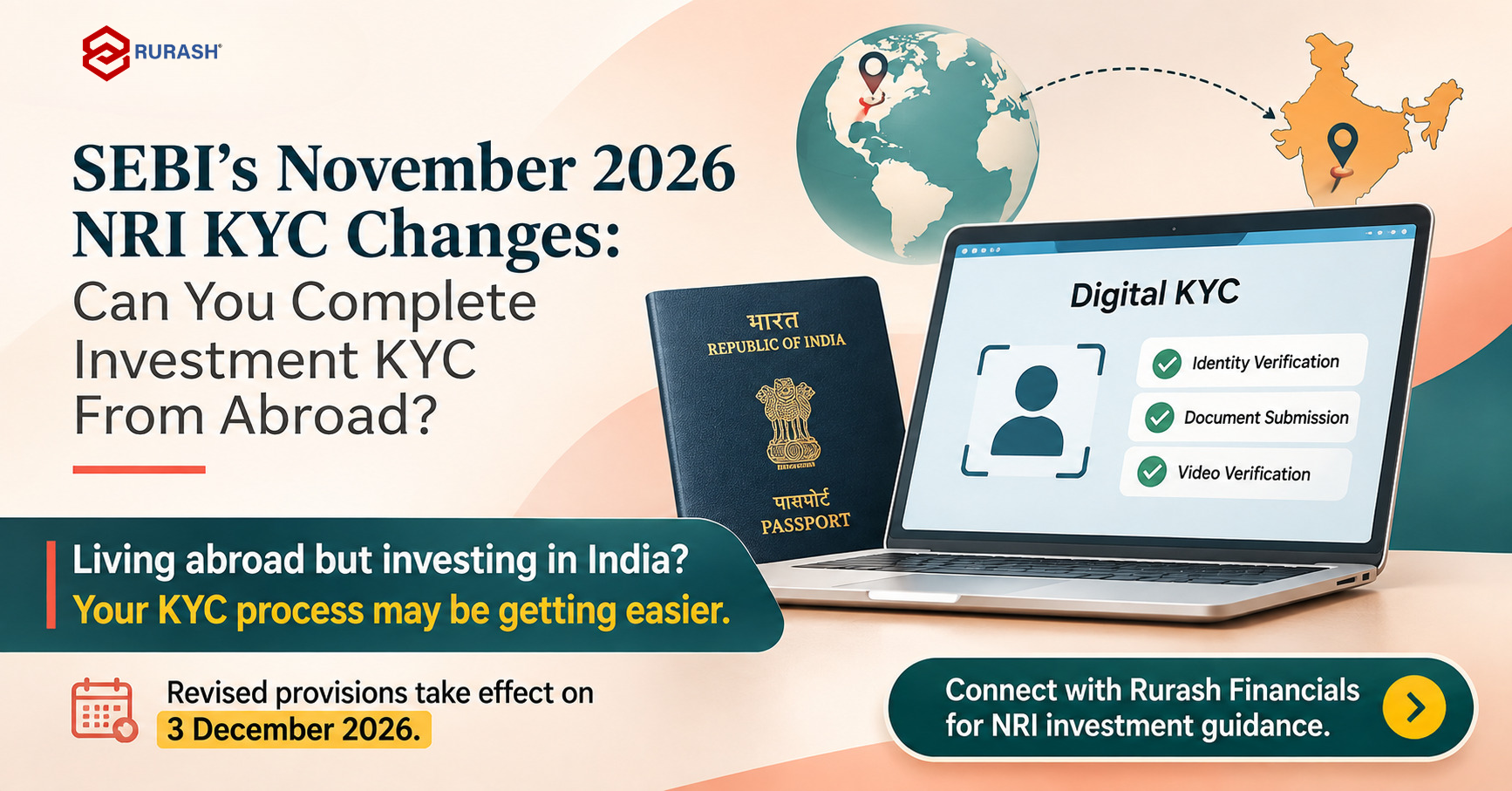
SEBI’s November 2026 NRI KYC Changes: Can You Complete Investment KYC From Abroad?
Hero insight: Living abroad but investing in India? Your KYC process may be getting easier.
For millions of Indians living overseas, financial connections with India continue long after they relocate.
Some maintain mutual fund investments. Others hold Indian equities, bonds or other eligible financial assets. Many want to begin investing in India while working or residing in another country.
However, completing Know Your Client (KYC) requirements has often created practical difficulties for overseas investors.
Verifying identity, submitting documents and meeting location-based requirements can make account opening or updating existing investment records more complicated.
That process is now set to change.
On 4 November 2026, the Securities and Exchange Board of India (SEBI) issued a circular titled Review of Know Your Client process for individual Person Resident Outside India clients.
The circular introduces revised digital KYC provisions for eligible overseas individuals, with implementation scheduled for 3 December 2026.
One of the most important changes is the relaxation of the earlier requirement that clients must be physically present in India during digital onboarding.
Eligible Non-Resident Indians (NRIs), Overseas Citizens of India (OCIs) and foreign nationals residing in FATF-compliant countries may be able to complete the relevant KYC process remotely through participating intermediaries.
The change is intended to make onboarding easier, but it does not eliminate identity verification, documentation or regulatory eligibility requirements.
What Happened? SEBI Revised the KYC Framework for Overseas Investors
SEBI’s earlier digital KYC framework generally required an intermediary to ensure that the client’s physical location was in India during the digital verification process.
For investors living overseas, this created a practical limitation.
Even where documents could be shared electronically, completing the full onboarding process from abroad could require additional arrangements.
The circular dated 4 November 2026 revises this framework for eligible individual Persons Resident Outside India (PROI).
Its main changes include permitting digital KYC submissions from eligible overseas locations, improving portability of KYC records, allowing greater use of existing verified information and strengthening controls over video verification.
SEBI NRI KYC UPDATE — KEY DATES
Circular issued
4 Nov 2026
Revised provisions effective
3 Dec 2026
Circular reference: HO/38/30/12(3)2026-MIRSD-POD2/I/25175/2026.
As of 9 November 2026, the revised provisions have been issued but are not yet effective. Existing rules continue to govern onboarding until implementation, subject to the circular’s transitional provisions.
For investors, the practical benefit is the possibility of completing more of the onboarding process without travelling to India.
However, the revised procedures must still be implemented by the relevant intermediary.
1. Who Can Use the Revised NRI KYC Process?
The circular covers eligible individual Persons Resident Outside India.
This includes NRIs, OCIs and foreign nationals.
The central eligibility requirement is that the individual must be located in a country compliant with the Financial Action Task Force (FATF) framework.
FATF is an international body that develops standards for combating money laundering, terrorist financing and related financial risks.
SEBI’s relaxation is therefore not an unconditional permission for every investor in every overseas jurisdiction.
For individuals residing in FATF non-compliant countries, the existing KYC process continues to apply.
Foreign nationals seeking registration as Foreign Portfolio Investors must follow the separately applicable FPI framework.
Investor takeaway: Your NRI or OCI status alone does not establish eligibility. Your country of residence and the applicable onboarding requirements also matter.
2. Can NRIs Complete Digital KYC Without Visiting India?
Under the revised provisions, eligible overseas investors can submit KYC information and supporting documents digitally, subject to the prescribed verification controls.
The earlier India-location restriction is being relaxed for qualifying individuals.
This is particularly relevant to investors who want to open an eligible securities-market account or update KYC records while residing overseas.
However, digital submission does not mean that identity verification becomes optional.
Intermediaries must still establish the client’s identity, verify the relevant information and understand the purpose and intended nature of the business relationship.
Certain applications may require additional supporting evidence, and intermediaries remain responsible for carrying out necessary due diligence.
The framework makes remote onboarding more accessible while retaining compliance obligations.
3. What Documents Should NRIs Prepare?
The exact documentation depends on the investor’s status and circumstances.
SEBI’s revised process includes PAN verification, passport details, relevant OCI documentation, proof of identity and proof of overseas address.
The intermediary may also need specimen signatures, contact information and additional documents where applicable.
A practical preparation checklist includes:
Information or document | Why it matters |
|---|---|
PAN | Used for identity verification against the income-tax database |
Valid passport | Supports identity and citizenship-related verification |
OCI card, if applicable | Supports relevant OCI status documentation |
Overseas address proof | Helps establish the current residential address |
CKYC ID, if available | Helps retrieve existing KYC records |
KYC form | Records required personal and relationship details |
Specimen signature | Supports signature verification |
Mobile number and email | Enables contact and verification |
Additional compliance information | May be required for risk assessment or specific investment eligibility |
SEBI’s circular permits specified physical and electronically signed KYC forms and provides mechanisms for verifying acceptable documents.
An important practical point is that the documents submitted must be in English. Documents in another language require translation into English and attestation by an appropriate certifying authority before submission.
4. How Will PAN Verification Work?
PAN remains an important component of the KYC process.
Under the revised framework, the intermediary is required to verify the investor’s PAN against the income-tax database.
The circular provides that the intermediary should not insist on producing the original PAN card or a copy merely for this verification.
The KYC Registration Agency (KRA) also verifies the PAN and corresponding name against the relevant database and marks that attribute as validated.
This may reduce unnecessary document duplication.
However, PAN verification does not remove other requirements relating to identity, overseas address, account eligibility or regulatory compliance.
5. What Is Video In-Person Verification?
Video In-Person Verification, commonly called VIPV, is a controlled identity-verification process conducted through video technology.
For eligible investors overseas, it provides an alternative to certain physical verification requirements.
However, the process is more than a routine video call.
SEBI’s revised provisions require an authorised official of the intermediary to be present during VIPV.
The process is also subject to concurrent audit and applicable technology and security requirements.
These controls are intended to help prevent impersonation and ensure the authenticity of the onboarding process.
For investors, this means that completing VIPV may require using the intermediary’s approved digital platform, following its instructions and providing the required verification information.
6. Does the Investor’s Overseas Location Still Matter?
Yes.
Although SEBI is relaxing the requirement to be physically present in India, overseas location remains relevant.
The new framework is linked to qualifying countries and contains controls relating to the geographical origin of digital verification.
The client’s location and supporting documents must satisfy the prescribed requirements.
Consequently, NRIs should not assume that they can complete onboarding from any country, through any network or under any circumstances.
It is advisable to confirm the intermediary’s process for the investor’s actual country of residence.
7. Will Existing KYC Records Be Reusable?
One of the more useful changes concerns portability of KYC records.
SEBI has provided that KYC records can be shared with another intermediary irrespective of whether every individual attribute is marked as validated.
The circular also permits intermediaries to rely on KYC previously completed by eligible regulated institutions using information available through KRAs or the Central KYC Records Registry (CKYCRR).
This can reduce repeated requests for information.
However, existing records may still require updates or further verification.
For example, an intermediary may seek additional information if the client’s overseas address has changed, a document has expired, existing records are incomplete or enhanced due diligence is necessary.
KYC portability does not mean that every future account can be opened without additional checks.
Business News – The Indian Express+1
8. What Happens If an NRI Already Has a Mutual Fund or Demat Account?
NRIs who already hold investments may have completed KYC under earlier rules.
The revised circular does not mean those existing records automatically become invalid.
It also does not require every overseas investor to immediately repeat their KYC.
Instead, the relevant intermediary will assess whether the existing records are complete and whether updates are necessary.
For instance, an investor may have moved from India to another country, changed residential address or obtained new identification documents.
Such changes can justify updating the relevant KYC information.
An investor seeking to open another account may also benefit from the ability of intermediaries to retrieve existing records, subject to verification and eligibility.
The best starting point is to check the current KYC status with the relevant investment intermediary.
9. What Responsibilities Will Intermediaries Have?
SEBI’s circular places important responsibilities on financial-market intermediaries.
These include verifying the client’s identity, retrieving available KYC records, collecting required documents and ensuring that any digital verification process satisfies the applicable safeguards.
Updated KYC information must be provided to the KRA within three working days after completion of the process.
Intermediaries are also responsible for maintaining appropriate cybersecurity and procedural controls.
These requirements matter because the success of overseas digital onboarding depends on secure and reliable implementation, not merely the electronic submission of documents.
Investors should therefore use authorised intermediary channels and avoid sharing sensitive identification documents or credentials with unverified parties.
10. Does Easier KYC Mean NRIs Can Invest in Every Indian Product?
No.
This is an important distinction.
KYC is a process for identifying and verifying a customer.
It is not, by itself, permission to invest in every financial product offered in India.
An NRI’s eligibility to invest in mutual funds, listed shares, bonds, unlisted equity or other instruments may depend on additional regulatory, product-specific and jurisdictional requirements.
Relevant considerations may include FEMA rules, permitted bank accounts, repatriation arrangements, investor classification and the investment restrictions applicable to the investor’s country of residence.
Some investment products or intermediaries may also have specific onboarding restrictions for residents of certain jurisdictions.
Therefore, completing KYC should be treated as one part of investment readiness, not the entire process.
11. What Should NRIs Check Before Starting KYC?
Before initiating onboarding or updating existing records, overseas investors should examine the following.
Country eligibility: Confirm whether the location qualifies under SEBI’s revised provisions.
Implementation date: Check that the intermediary is operating under the applicable framework.
PAN and identity details: Ensure names and identification records are consistent.
Passport and OCI documents: Keep the required documents available and valid.
Overseas address: Prepare acceptable current address evidence.
Existing KYC status: Check whether the intermediary can retrieve existing KRA or CKYC records.
Video verification: Understand the approved VIPV procedure and any location requirements.
Investment eligibility: Confirm product-specific rules and applicable banking requirements.
Contact details: Ensure that mobile and email information can be verified.
Data security: Submit documents only through official, authorised channels.
A structured review can help reduce avoidable back-and-forth during onboarding.
12. Why Does This Matter for NRI Investment Planning?
For an NRI, investing in India involves more than selecting a mutual fund or evaluating a stock.
The investor must also consider account documentation, currency movement, taxation, repatriation, liquidity and portfolio objectives.
Administrative difficulties can sometimes prevent investors from reviewing or updating long-standing holdings.
A more accessible KYC framework may help reduce some of these procedural barriers.
However, the financial decisions that follow remain equally important.
An investor returning to India in the future may have different liquidity and currency requirements from someone expecting to remain overseas.
Similarly, a family maintaining financial commitments in both countries may need to assess overall asset allocation rather than looking only at Indian investments.
Simpler onboarding can improve access, but thoughtful investment planning still requires understanding the investor’s complete financial position.
Ranjit Jha’s Perspective — Draft for Approval
Proposed editorial perspective for Ranjit M. Jha, MD & CEO, Rurash Financials. Approval required before attribution.
SEBI’s revised KYC framework represents a meaningful development for overseas individuals seeking access to India’s securities markets.
For NRIs and OCIs, the ability to complete eligible onboarding requirements remotely may reduce procedural difficulties and improve the investor experience.
However, greater convenience should be accompanied by careful attention to identity verification, documentation, regulatory eligibility and data security.
Overseas investors should also assess how their Indian investments fit within their broader financial objectives, including liquidity, taxation and cross-border requirements.
The value of easier market access lies in enabling investors to make informed decisions through a more accessible and appropriately regulated process.
Explore More with Rurash
At Rurash Financials, we understand that managing investments in India while living abroad can involve additional documentation, regulatory considerations and financial-planning decisions.
For NRIs and OCIs exploring Indian mutual funds, equities, bonds and other eligible investment opportunities, understanding the applicable KYC process is an important starting point.
Through Rurash’s NRI investment and wealth management solutions, eligible investors can explore investment opportunities while considering account requirements, financial objectives and relevant regulatory conditions.
Living abroad should not mean losing clarity over your investments in India.