
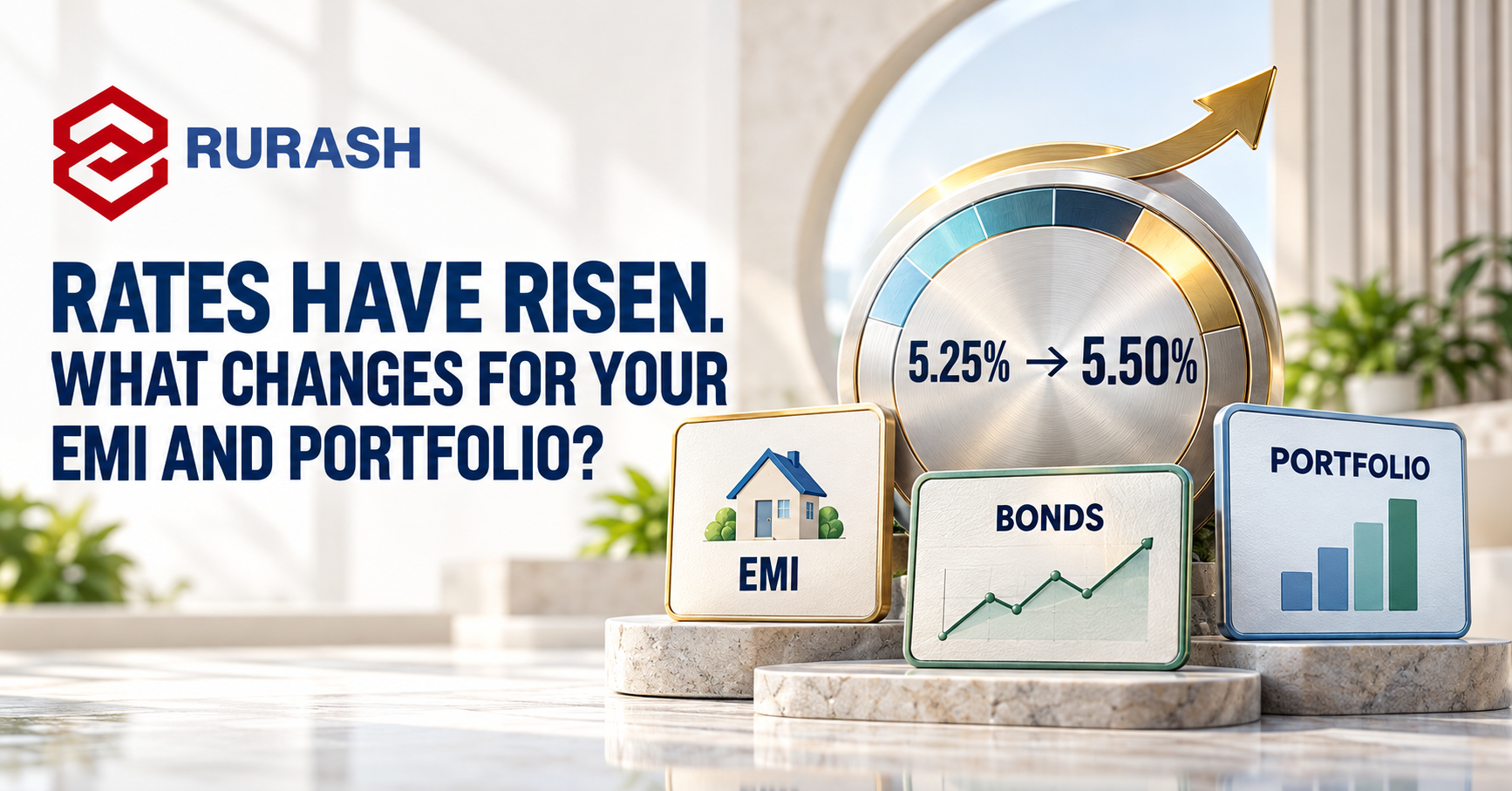
RBI’s October Rate Hike: What Investors and Borrowers Should Review
The RBI has raised the repo rate. But the impact on your EMI, deposits and investment portfolio may not appear in the same way—or at the same time.
On October 7, 2026, the Reserve Bank of India increased the policy repo rate by 25 basis points, from 5.25% to 5.50%.
This was India’s first repo-rate increase in nearly four years. The Monetary Policy Committee also changed its stance from “neutral” to “calibrated tightening,” indicating greater attention to inflation risks while keeping future decisions dependent on economic data.
For borrowers, the immediate concern is whether loan rates and EMIs will rise.
For investors, the questions are broader. How could higher rates affect bonds, debt funds, fixed deposits, equities and borrowing-backed investment decisions?
The useful response is not to make an immediate portfolio change based only on the policy headline. It is to identify which parts of your financial position are actually sensitive to interest rates.
Why did the RBI raise the repo rate?
The repo rate is the rate at which the RBI lends short-term funds to eligible banks against approved securities.
A higher repo rate increases the policy cost of money in the financial system. Over time, this can influence bank lending rates, deposit rates, money-market yields and broader financial conditions.
The October decision came as inflation risks were building due to higher energy costs, food-price pressures, a weaker rupee and global financial conditions. At the same time, relatively strong economic and credit growth gave the RBI room to focus more closely on inflation.
A rate increase does not reduce every price immediately. Its effect works through the financial system by making borrowing more expensive, moderating demand and influencing inflation expectations.
Does every borrower’s EMI increase immediately?
No.
The effect depends on the loan’s interest-rate structure, benchmark and reset terms.
A borrower should first establish whether the loan is:
- Fixed-rate or floating-rate
- Linked to the repo rate or another external benchmark
- Linked to the lender’s MCLR or an internal benchmark
- Subject to a monthly, quarterly or other reset schedule
A floating-rate loan linked to an external benchmark may respond more directly to a policy-rate change. However, the revision generally becomes effective according to the loan’s reset schedule and lender terms.
A genuinely fixed-rate loan may not change merely because the repo rate has increased. Borrowers should nevertheless read the agreement carefully because some products described as fixed may be fixed only for an initial period.
Do not assume that a 25-basis-point repo-rate increase automatically produces an identical and immediate increase in every loan.
Check whether the lender changes the EMI or tenure
When a floating loan becomes more expensive, the lender may adjust the repayment schedule in different ways.
Depending on the loan terms and the options available, the lender could:
- Increase the monthly EMI
- Extend the remaining tenure
- Use a combination of EMI and tenure changes
- Offer the borrower an option to make a partial prepayment
- Require another adjustment if the maximum permissible tenure is reached
A longer tenure may keep the immediate EMI increase smaller, but it can result in more interest being paid over the remaining life of the loan.
This is why borrowers should not evaluate the effect only by asking, “How much did my EMI increase?”
They should also ask:
“How has the total remaining interest changed?”
Request an updated repayment schedule showing the revised EMI, tenure and total interest payable.
Review home, vehicle and business loans separately
Different borrowings may respond differently to the same policy decision.
For each loan, record:
- Current outstanding balance
- Existing interest rate
- Interest-rate benchmark
- Spread or margin charged by the lender
- Next reset date
- Remaining tenure
- Current EMI
- Prepayment terms
- Applicable switching or refinancing charges
A home loan with a long remaining tenure can be particularly sensitive to rate changes because interest is paid over many years.
A shorter vehicle or personal loan may have a smaller remaining interest period, but its rate may already be higher.
Business borrowers should also assess the effect on working-capital facilities, overdrafts and new funding requirements. Even a modest rate increase can affect cash-flow planning when a business uses multiple floating-rate facilities.
Should borrowers prepay immediately?
Not necessarily.
Prepayment can reduce future interest, but it should not weaken the borrower’s liquidity position.
Before using surplus funds to repay a loan, consider:
- Whether an adequate emergency reserve will remain
- Whether the funds are needed for near-term obligations
- Whether the loan permits prepayment without material charges
- The effective interest cost of the borrowing
- The tax treatment applicable to the borrower
- Whether the prepayment will reduce EMI, tenure or both
A borrower should also avoid redeeming long-term investments impulsively merely because rates have increased by 25 basis points.
The decision should compare the benefit of reducing debt with the cost, tax impact and portfolio consequences of selling the investment.
What could the rate hike mean for bond prices?
Bond prices and market yields generally move in opposite directions.
When market interest rates rise, existing fixed-rate bonds can become less attractive relative to newly issued securities offering higher yields. Their market prices may therefore decline.
The impact is usually greater for bonds with:
- Longer maturity
- Longer duration
- Lower coupons
- Greater sensitivity to interest-rate movements
Shorter-duration instruments are normally less sensitive to a given rate movement, although they are not free from interest-rate or credit risk.
Investors holding a bond until maturity may still receive the contractual coupon and principal, subject to the issuer meeting its obligations. However, the bond’s market value can fluctuate before maturity.
An investor who may need to sell early should pay particular attention to both interest-rate sensitivity and secondary-market liquidity.
What should debt-fund investors review?
Debt mutual funds hold portfolios of bonds and money-market instruments. Their net asset values can respond to changes in market yields.
Long-duration funds may experience greater price movement when yields rise. Short-duration and money-market strategies usually have lower duration sensitivity, although their returns and risks depend on the underlying portfolio.
Debt-fund investors should review:
- Modified duration
- Average maturity
- Yield to maturity
- Credit quality
- Concentration by issuer
- Exit load
- Investment horizon
- Tax treatment
- The purpose of the allocation
A decline in a debt fund’s NAV after a rate increase does not automatically mean the fund is unsuitable. The relevant question is whether the fund’s duration and credit profile remain aligned with the investor’s horizon and risk tolerance.
As existing securities mature and portfolios reinvest at potentially higher yields, future accrual opportunities may improve. However, this adjustment takes time and varies across funds.
Could fixed-deposit rates rise?
Banks may revise deposit rates when funding requirements and market conditions change, but a repo-rate increase does not guarantee that every bank will immediately raise every deposit rate.
The response can differ across:
- Banks and non-bank institutions
- Deposit tenures
- Deposit sizes
- Senior-citizen products
- Callable and non-callable deposits
- New and existing deposits
Existing fixed-rate deposits normally continue at their contracted rate until maturity unless their terms say otherwise.
Investors considering a new deposit should avoid concentrating the entire amount in one tenure solely because rates may rise further.
A deposit ladder—dividing money across different maturity dates—can provide periodic liquidity and opportunities to reinvest without requiring a prediction about the next RBI decision.
What about equity investors?
Higher interest rates can affect companies through borrowing costs, consumer demand and valuation.
Businesses with high debt, weak cash flows or regular refinancing requirements may face greater pressure if financing costs rise.
Rate-sensitive sectors may include:
- Banks and financial services
- Housing and real estate
- Automobiles
- Consumer durables
- Infrastructure
- Capital-intensive businesses
However, the effect is not uniform.
Banks may benefit from certain changes in lending yields, but their deposit costs, funding mix, asset quality and loan demand also matter. A company with low leverage and strong pricing power may be better positioned than a highly indebted competitor in the same sector.
Equity investors should therefore avoid making a portfolio decision based only on the label “rate-sensitive.”
Avoid borrowing to invest without reviewing the new cost
A higher-rate environment deserves particular attention when investments are funded through loans, margin facilities or Loan Against Securities arrangements.
The investment must now overcome a potentially higher borrowing cost before producing a positive outcome for the investor.
The investor also continues to carry:
- Market risk
- Interest expense
- Repayment obligations
- Collateral-shortfall risk, where applicable
- The possibility that the investment horizon and loan tenure will not match
A rate hike does not automatically make every securities-backed loan unsuitable. It does make the repayment plan and total borrowing cost more important.
Do not assume the October hike guarantees another hike
The shift to “calibrated tightening” suggests that the RBI is paying closer attention to inflation and may remain willing to act.
It does not guarantee a fixed sequence of future rate increases.
Future decisions can depend on:
- Inflation data
- Food and energy prices
- Crude-oil movements
- Rupee conditions
- Economic growth
- Credit expansion
- Global interest rates
- Financial-market stability
Reuters reported that economists and market participants were considering the possibility of additional tightening, but the eventual path will depend on evolving conditions.
Borrowers and investors should prepare for more than one possible rate scenario rather than structuring their finances around a single forecast.
A practical review after the rate hike
Instead of reacting to the headline, divide the review into three parts.
For borrowers
Check the benchmark, reset date, revised repayment schedule, remaining interest and prepayment options.
For fixed-income investors
Review duration, maturity, credit quality, liquidity and whether the investment horizon matches the product.
For portfolio investors
Examine debt-heavy companies, borrowing-funded investments and whether the overall asset allocation remains appropriate.
The objective is not to predict every future RBI decision. It is to understand how sensitive your finances are if rates remain elevated or rise further.
Ranjit Jha’s Perspective — Draft for Approval
Unapproved proposed perspective; not an authorised quotation.
From the investor-education perspective of Ranjit Jha, MD & CEO of Rurash Financials, a policy-rate change should lead to a review rather than an automatic portfolio reaction.
Borrowers should understand whether their loan is actually linked to the repo rate, when the next reset will occur and whether the lender is changing the EMI, tenure or both.
Investors should examine duration, credit quality and liquidity instead of treating all fixed-income products alike. The useful question is not only where interest rates may move next, but whether the current portfolio and repayment commitments remain suitable under more than one rate scenario.
Connect With Rurash Financials
The RBI’s October rate hike can affect borrowing costs, bond valuations, debt-fund performance and portfolio decisions in different ways.
Rurash Financials can help investors review their fixed-income allocation, securities-backed borrowing and wider investment portfolio in the context of changing interest rates.
Explore Rurash → Connect with Rurash Financials
Interest rates, deposit terms, loan resets and investment outcomes vary across institutions and products. This article is for investor education and should not be treated as personalised investment, tax or borrowing advice