
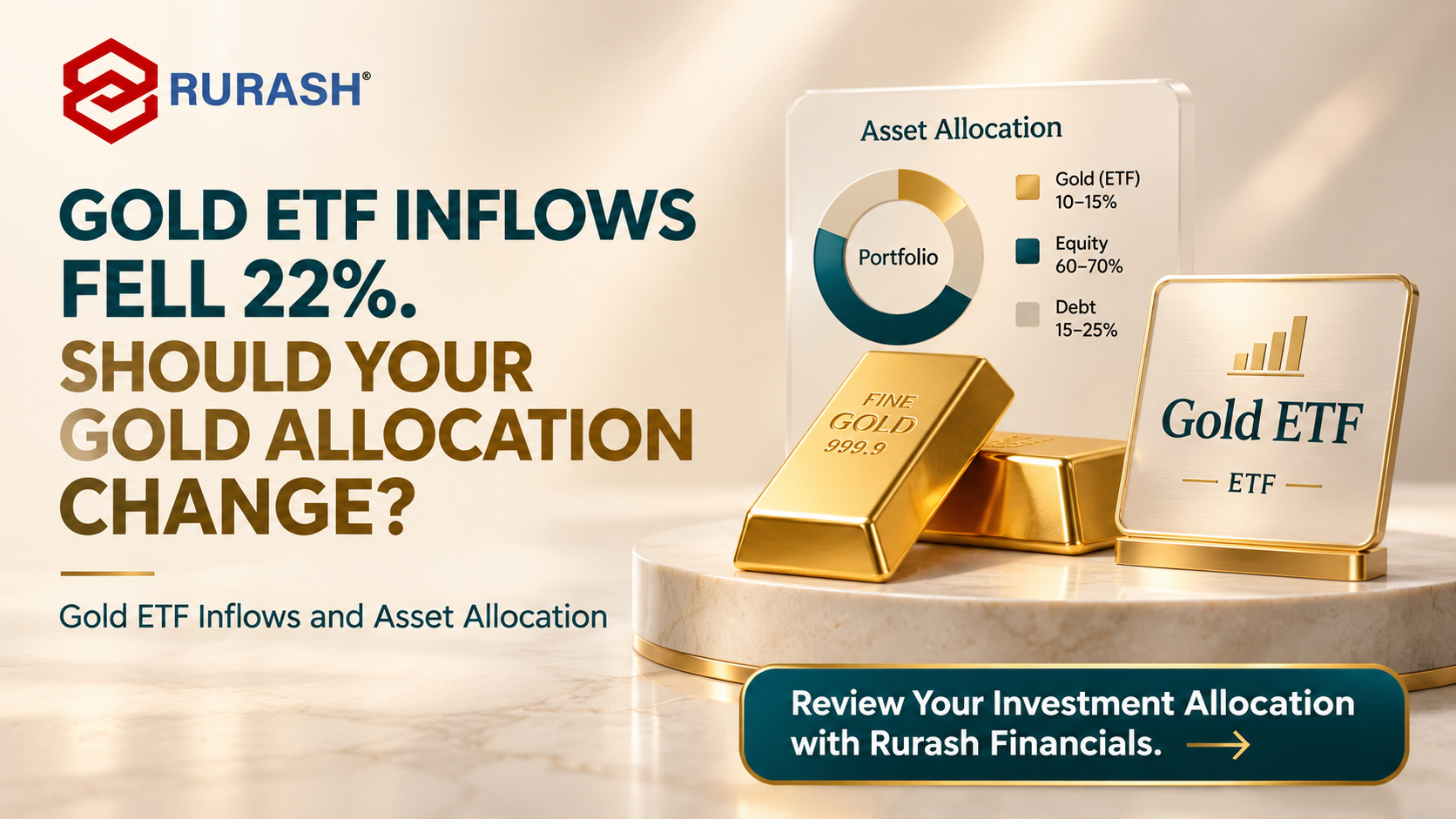
Hook: Gold remains a popular investment. But should investor flows influence how much gold you own?
Gold has long occupied a special place in Indian households.
For some families, buying gold is connected with celebrations, traditions and long-term savings. For others, gold serves as a financial asset that may provide diversification alongside equities and fixed-income investments.
Over the years, Gold Exchange-Traded Funds (ETFs) have provided investors with another way to obtain exposure to gold without physically storing jewellery, coins or bars.
However, investors can sometimes confuse the popularity of gold with the suitability of a gold investment for their own portfolio.
On 11 November 2026, data released by the Association of Mutual Funds in India (AMFI) showed that net inflows into Indian gold ETFs declined by approximately 22% in October compared with September.
Gold ETFs continued receiving positive net investments. What declined was the pace of inflows, not necessarily the price of gold or the value of existing holdings.
For investors, this creates an opportunity to understand gold ETFs, their costs, liquidity and appropriate role in asset allocation.
What Happened? Gold ETF Inflows Moderated in October
According to AMFI data reported by Reuters and NDTV Profit on 11 November 2026, Indian gold ETFs attracted approximately ₹3,474 crore in net inflows during October.
This compared with approximately ₹4,451 crore in September, representing a decline of about 21.94%.
INDIAN GOLD ETF NET INFLOWS
September 2026
₹4,451 Cr
October 2026
₹3,474 Cr
−21.94%
Month-on-month change in net inflows
Reuters reported that fund houses had suspended certain fresh subscriptions and bulk purchases ahead of the festive season, amid concerns related to gold imports and currency pressures.
This context matters because ETF flows can be influenced by fund-level operational decisions, investor subscriptions, redemptions and market conditions.
Investors should not automatically interpret one month’s lower inflows as a negative outlook for gold.
1. What Does a Decline in Gold ETF Inflows Actually Mean?
An ETF’s net inflow represents the difference between new investment money entering and money leaving over a specified period, based on the relevant reporting convention.
A decline in net inflows means that the amount of fresh money entering the category has decreased compared with an earlier period.
It does not necessarily mean that investors are collectively withdrawing money.
For example, October’s positive net inflows of approximately ₹3,474 crore still indicate that more money entered the category than left it during the month.
A decline in the rate of inflows should therefore not be confused with net outflows.
Investor takeaway: ETF flows indicate investor activity. They do not directly measure investment returns.
2. Are Gold Prices and Gold ETF Inflows the Same Thing?
No.
Gold prices reflect developments in the international and domestic gold markets.
Factors influencing gold prices can include global interest rates, inflation expectations, currency movements, central-bank demand, geopolitical uncertainty and broader financial-market conditions.
ETF inflows measure investor activity within a particular investment structure.
These measures may influence one another in certain market conditions, but they are not identical.
For example, gold prices may rise while ETF inflows slow.
Alternatively, investors may increase ETF purchases during a period when gold prices decline.
Therefore, investors should examine price movements separately from fund-flow statistics.
A fall in gold ETF inflows is not a forecast that gold prices will fall.
3. What Is a Gold ETF?
A Gold ETF is an exchange-traded mutual fund scheme designed to provide exposure to domestic gold prices through its permitted investments.
Depending on applicable regulations and scheme documents, these investments can include physical gold and other eligible gold-related instruments.
Gold ETF units are listed and traded on recognised stock exchanges.
Investors generally buy and sell units through a demat and trading account.
This allows them to participate in gold-price movements without personally storing physical gold.
However, the value of the ETF can fluctuate with gold prices and other factors, including expenses, tracking differences and market trading conditions.
Gold ETFs are not fixed-return products.
4. Physical Gold vs Gold ETFs: What Is the Difference?
Physical gold and Gold ETFs can serve different purposes.
Jewellery may provide cultural, personal or emotional value alongside its underlying gold content.
Gold bars and coins are held directly in physical form.
Gold ETFs primarily serve as investment instruments.
Factor | Physical gold | Gold ETFs |
|---|---|---|
Ownership | Physical item | Units of an exchange-traded scheme |
Storage | Requires physical custody | Held through demat infrastructure |
Purchase costs | May include making charges, premiums and applicable taxes | Includes market and transaction costs |
Ongoing expenses | Storage or insurance, where applicable | Expense ratio and relevant account charges |
Liquidity | Depends on buyer, form and transaction conditions | Depends on exchange trading and market liquidity |
Price realisation | May involve purity checks and resale deductions | Depends on market price and tracking behaviour |
Primary purpose | Personal use, holding or investment | Market-linked gold exposure |
Neither format is automatically superior for every purpose.
Jewellery intended for family use should not be assessed in exactly the same way as a market-linked investment product.
For an investor seeking gold exposure without physical storage, Gold ETFs may be worth considering alongside other suitable options.
5. Why Does the Gold ETF Expense Ratio Matter?
An ETF incurs costs for managing and operating the scheme.
These expenses are reflected through the scheme’s expense ratio and affect returns relative to the underlying benchmark.
For example, two Gold ETFs tracking similar gold-price exposure may report different net results because of variations in costs, portfolio management and other implementation factors.
Investors should examine the current expense ratio disclosed by each scheme.
However, the lowest expense ratio should not be the only consideration.
Tracking difference, market liquidity, bid-ask spreads and the fund’s implementation quality also matter.
6. What Is Tracking Difference?
Tracking difference measures the difference between the performance of an ETF and the performance of its stated benchmark over a relevant period.
A Gold ETF is designed to follow a gold-related benchmark, but its returns may not match the benchmark exactly.
Differences can arise from management expenses, cash holdings, transaction costs, valuation methods and operational factors.
For example, if a gold benchmark increases by 10% over a particular period and the ETF’s NAV increases by 9.5%, the tracking difference is 0.5 percentage points for that period.
This is a simplified illustration, not a prediction.
Investors should review historical tracking differences over meaningful periods rather than relying on one observation.
7. Tracking Error and Tracking Difference Are Not Identical
These terms are sometimes used interchangeably, but they describe different things.
Tracking difference measures the performance gap between the ETF and benchmark over a stated period.
Tracking error measures the variability of the ETF’s return differences relative to the benchmark, using an applicable statistical methodology.
An ETF may have a relatively consistent performance shortfall because of expenses while still exhibiting relatively low tracking error.
Investors evaluating passive investment products should therefore understand both concepts.
8. How Liquid Are Gold ETFs?
Gold ETFs trade on stock exchanges, but liquidity can differ between schemes.
An investor selling ETF units may be affected by trading volume, market depth and the bid-ask spread.
The bid-ask spread is the difference between the price at which market participants are willing to buy and sell.
A wider spread can increase the cost of entering or exiting an investment.
Investors should also compare the exchange-traded price with the ETF’s indicative or published NAV where relevant.
An ETF being listed does not guarantee that every transaction will occur at exactly its underlying NAV.
For larger transactions, the availability of market participants and creation-redemption mechanisms can also influence execution quality.
9. Can Gold ETFs Help Diversify an Investment Portfolio?
Gold is often considered as part of a diversified investment portfolio because its performance drivers may differ from those of equities and certain fixed-income assets.
In some market environments, gold may perform relatively well when other financial assets face pressure.
However, the relationship is not constant.
Gold can experience significant price declines and prolonged periods of weak performance.
It also does not generate interest or dividends in the same way that certain debt instruments or equity investments may.
Its investment return primarily depends on changes in market value, after applicable costs.
Therefore, gold should be evaluated as one component of an overall asset-allocation strategy rather than a guaranteed source of stability.
10. How Much Gold Should an Investor Hold?
There is no universal gold allocation suitable for every investor.
The appropriate exposure depends on existing investments, financial goals, risk capacity, liquidity requirements and investment horizon.
For example, an investor who already owns substantial physical gold may have greater total gold exposure than is visible in the demat portfolio.
Adding a Gold ETF could increase that concentration.
Likewise, an investor with significant equity exposure may consider whether a measured allocation to gold has an appropriate role in diversification.
The decision should be based on the overall portfolio, not solely on recent gold-price movements or monthly ETF flow data.
The question is not how much gold other investors are buying. It is how much gold makes sense within your financial plan.
11. Should Investors Buy Gold Because ETF Inflows Are Rising?
Not automatically.
Large inflows can reflect investor interest, but popularity does not guarantee future performance.
Likewise, declining inflows do not prove that gold has become unsuitable.
Short-term flows may be affected by institutional transactions, subscription restrictions, portfolio rebalancing and temporary market sentiment.
For long-term investors, asset allocation, valuation considerations, costs and liquidity are generally more meaningful than reacting to one month’s industry data.
Investors should avoid using ETF inflows as a standalone buy or sell signal.
12. What About Taxation?
Gold ETF investments can have tax implications that depend on the acquisition date, holding period, applicable law and the investor’s status.
Different historical tax regimes may apply to investments acquired during different periods.
Tax rules can also change.
Investors should therefore verify the treatment applicable to their particular holdings rather than relying on an outdated assumption that every Gold ETF transaction receives the same capital-gains treatment.
Taxation should be assessed alongside expenses and market risks when comparing gold investment formats.
Gold ETF Investment Checklist
What to review | Question to ask |
|---|---|
Investment objective | Why am I adding gold to my portfolio? |
Existing exposure | How much physical and financial gold do I already own? |
Expense ratio | What are the scheme’s ongoing costs? |
Tracking difference | How closely has the ETF followed its benchmark? |
Tracking error | How consistently does it track? |
Liquidity | Are trading volumes and bid-ask spreads reasonable? |
Market price | Is the traded price close to its underlying value? |
Time horizon | Can I tolerate gold-price volatility? |
Taxation | What rules apply to my acquisition and sale? |
Portfolio suitability | Does the allocation support diversification and financial goals? |
What Does October’s Decline Mean for Long-Term Investors?
The October 2026 data illustrates why investors should separate monthly fund flows from personal investment decisions.
Gold ETFs continued to attract positive net inflows, although the amount was lower than in September.
For investors considering gold exposure, the more useful questions concern investment format, transaction costs, tracking quality, liquidity and overall asset allocation.
A monthly change in industry demand may provide market context, but it does not determine the appropriate decision for an individual portfolio.
Ranjit Jha’s Perspective — Draft for Approval
Proposed editorial perspective for Ranjit M. Jha, MD & CEO, Rurash Financials. Approval required before attribution.
The moderation in Gold ETF inflows during October 2026 highlights the importance of distinguishing market participation from individual investment suitability.
Gold can play a role in portfolio diversification, but that role should be determined through asset allocation and financial planning rather than short-term demand trends.
Investors evaluating Gold ETFs should understand expenses, tracking differences, liquidity and the relationship between gold exposure and their existing investments.
A disciplined approach considers how the asset contributes to overall portfolio objectives without assuming that popularity or recent price movements will continue.
Explore More with Rurash
At Rurash Financials, we believe investment allocation should reflect financial goals, risk capacity and an understanding of the different roles assets can play within a portfolio.
For investors considering Gold ETFs, mutual funds and other market-linked investments, reviewing total exposure, diversification and investment costs can help support informed decisions.
Gold can be part of a portfolio. The right allocation depends on the investor.