
GIFT City Mobilises Nearly $53 Billion in FCNR(B) Funds—Why Does It Matter for NRI Investors?
GIFT City’s growing scale is expanding India’s international financial ecosystem—but NRI investors must still assess product suitability, taxation and currency exposure.
GIFT City has emerged as an important channel for foreign-currency flows into India.
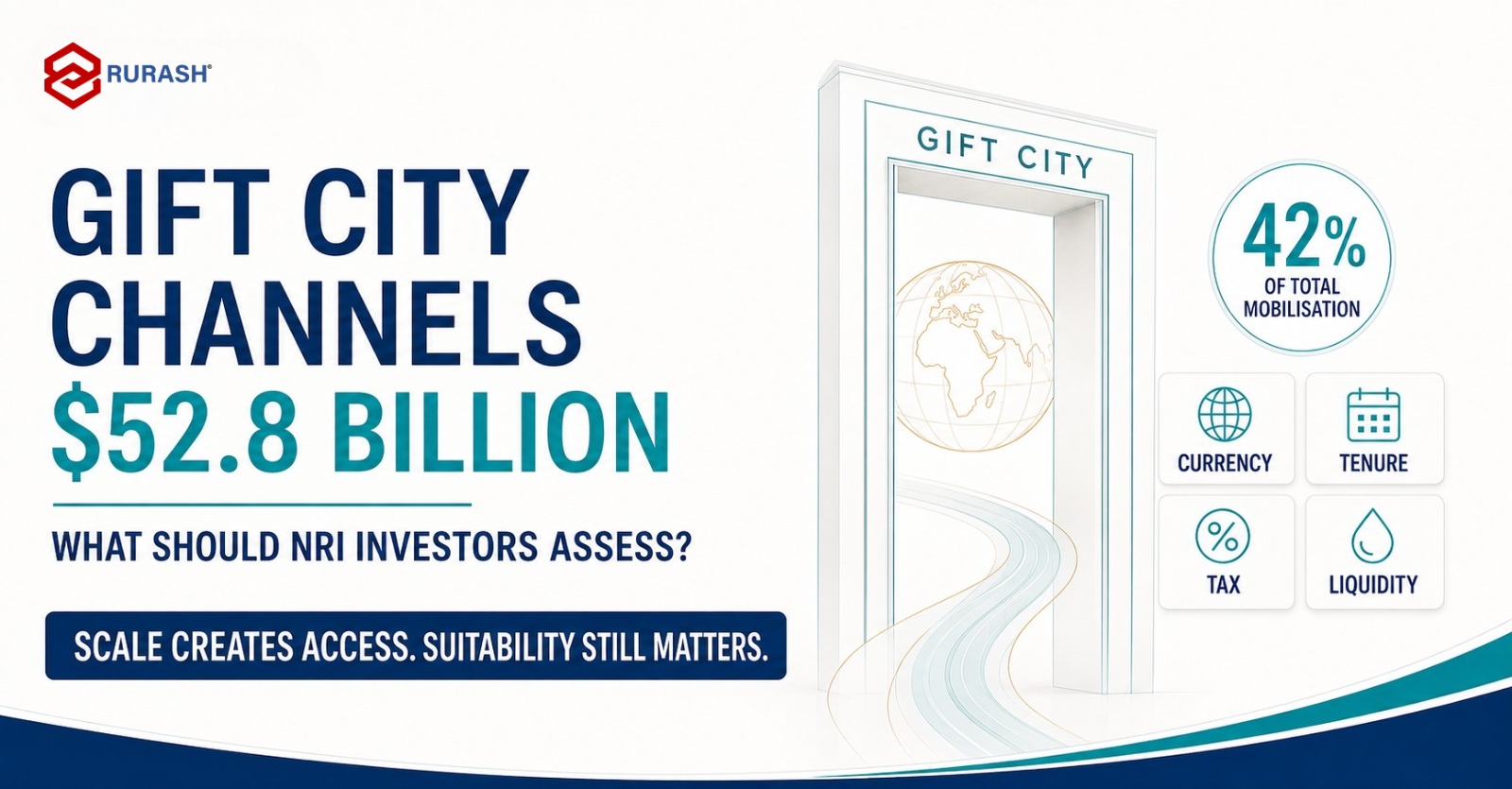
According to a report published on 3 September 2026, International Banking Units at GIFT City’s International Financial Services Centre facilitated approximately $52.82 billion under the Reserve Bank of India’s special FCNR(B) swap facility.
This represented nearly 42% of the total $127.2 billion mobilised through the facility—highlighting GIFT City’s expanding role in international banking and foreign-currency financing. Financial Express
For Non-Resident Indians, however, the large mobilisation figure should not be viewed as an investment recommendation by itself. An FCNR(B) deposit must still be evaluated on its interest rate, currency, tenure, liquidity, tax treatment and connection with the investor’s future financial goals.
What Happened?
The RBI introduced a special foreign-exchange swap facility on 5 June 2026 to encourage Indian banks to raise fresh FCNR(B) deposits with maturities ranging from three to five years.
The facility came at a time when the Indian rupee and the country’s balance-of-payments position were facing pressure amid the West Asia conflict.
Under the arrangement, banks could mobilise foreign-currency deposits from NRIs and swap the funds with the RBI under specified conditions. This helped banks bring foreign currency into the country while managing part of the associated exchange-rate risk.
By 31 August 2026:
- Approximately $127.2 billion had reportedly been mobilised through FCNR(B) deposits.
- GIFT City’s International Banking Units facilitated around $52.82 billion.
- GIFT City therefore accounted for nearly 42% of the reported mobilisation.
The International Financial Services Centres Authority also highlighted the $52.8 billion mobilisation as evidence of GIFT IFSC’s growing position as an international banking hub. IFSCA
What Is an FCNR(B) Deposit?
FCNR(B) stands for Foreign Currency Non-Resident (Bank) account.
It is a term-deposit facility offered by eligible Indian banks to NRIs and Persons of Indian Origin. Unlike an NRE fixed deposit, which is maintained in Indian rupees, an FCNR(B) deposit is maintained in an eligible foreign currency.
Depending on the bank, deposits may be available in currencies such as:
- US dollar
- British pound
- Euro
- Japanese yen
- Australian dollar
- Canadian dollar
The depositor places money in the selected foreign currency, earns interest in that currency and generally receives the maturity proceeds in the same currency.
This can help an NRI avoid direct Indian-rupee depreciation risk on the deposit. However, it does not remove every form of currency risk.
Why Did Banks Raise So Many Foreign-Currency Deposits?
The RBI’s special swap facility gave banks an additional reason to mobilise FCNR(B) deposits.
Strengthening foreign-exchange inflows
Large foreign-currency deposits increase the flow of overseas funds into India. Such inflows can support the country’s foreign-exchange position during periods of external pressure.
Accessing longer-term foreign-currency funding
The special facility focused on deposits with maturities of three to five years. This gives banks access to relatively stable foreign-currency resources instead of relying only on shorter-term funding.
Managing currency risk through the RBI swap
Banks accepting foreign-currency deposits must eventually repay depositors in the same currency. Currency movements can therefore create risk for the bank.
Through the swap facility, eligible foreign currency could be exchanged with the RBI under predetermined terms, helping participating banks manage this exposure more effectively.
Supporting foreign-currency financing
The funds can strengthen banks’ ability to support international lending and other permissible foreign-currency activities, subject to regulatory requirements.
The mobilisation was therefore primarily a bank-funding and macroeconomic development. The benefit available to an individual NRI depends on the actual deposit terms offered by the bank.
What Role Did GIFT City Play?
GIFT City’s International Financial Services Centre allows regulated institutions to conduct international financial activities from India.
International Banking Units operating within the IFSC can undertake foreign-currency banking activities and connect Indian financial institutions with global capital.
In the FCNR(B) mobilisation, GIFT City acted as a major channel through which participating banks accessed and deployed foreign-currency funds. The scale suggests that GIFT IFSC is developing beyond its original positioning as an emerging financial centre and becoming a meaningful part of India’s cross-border financial infrastructure.
The same period also saw:
- $11.62 billion in external commercial borrowings disbursed through GIFT City IBUs.
- $11.12 billion raised by banks through bond issuances on IFSC exchanges.
These figures point towards a wider ecosystem involving international banking, borrowing, bond issuance and foreign-currency financial services—not only FCNR(B) deposits.
IFSCA also notes that banks in GIFT IFSC can provide NRIs with foreign-currency accounts and deposits in currencies such as the US dollar, euro and British pound. IFSCA’s NRI guidance
Why Does This Matter for NRI Investors?
More international financial activity within India
NRIs are gaining access to a broader range of foreign-currency banking and investment services through a financial centre located within India’s regulatory ecosystem.
Greater competition among financial institutions
As more banks and institutions operate through GIFT City, competition may improve product variety, service quality and access to foreign-currency solutions.
This does not mean every product will offer a better return. Investors must compare actual terms instead of relying on the GIFT City label.
Improved foreign-currency planning options
An NRI with future expenses in dollars, pounds or euros may find foreign-currency deposits useful for matching assets with expected liabilities.
For example, an investor expecting to pay education expenses in US dollars may prefer keeping part of the portfolio in dollars rather than converting everything into rupees.
A broader role in NRI portfolio construction
GIFT City may offer access to banking, funds, bonds and other international financial products. This can help NRIs construct portfolios that reflect their residence, income currency, future liabilities and India-related financial goals.
Product availability alone, however, is not a reason to invest. Suitability remains essential.
Do FCNR(B) Deposits Remove Currency Risk?
FCNR(B) deposits can reduce exposure to the Indian rupee because both the deposit and its repayment are denominated in a foreign currency.
If an investor places US dollars into a US-dollar FCNR(B) deposit and receives the proceeds in US dollars, changes in the rupee-dollar exchange rate do not directly alter the deposit’s dollar value.
But other risks may remain.
An NRI earning in pounds and investing in a US-dollar deposit would still face GBP–USD currency risk. Similarly, an investor planning to use the maturity proceeds in India will eventually need to convert the money into rupees, making the final rupee value dependent on the exchange rate at that time.
The right deposit currency should therefore be linked to the investor’s:
- Income currency
- Country of residence
- Future spending currency
- Existing assets and liabilities
- Planned use of the maturity proceeds
Choosing a foreign currency only because its deposit rate appears higher can introduce an unnecessary exchange-rate risk.
Are FCNR(B) Deposits Fully Repatriable?
FCNR(B) principal and interest are generally repatriable in foreign currency, subject to applicable rules and banking procedures.
This is useful for NRIs who may need to move funds back to their country of residence or use the money for overseas financial goals.
Repatriability should still be distinguished from liquidity. A deposit may be repatriable but remain locked until maturity unless the depositor chooses premature withdrawal.
Banks are required to permit premature withdrawal, but they may apply a penalty. If withdrawal occurs before the minimum stipulated period, interest may not be payable, subject to the prevailing rules and deposit terms. RBI guidance
What Should NRIs Compare Before Investing?
1. Deposit currency
Select a currency connected with future liabilities or existing income. Avoid taking an unrelated currency position merely to earn a higher advertised rate.
2. Interest rate
Compare rates across banks and currencies. A higher nominal rate should be evaluated along with currency movements, tenure and liquidity restrictions.
3. Tenure
A longer tenure may provide rate visibility but can also restrict access to funds. The maturity date should correspond with the investor’s financial goal.
4. Premature-withdrawal conditions
Review whether the bank applies a penalty and whether any interest will be payable if the deposit is closed early.
5. Taxation
Interest on qualifying FCNR(B) deposits is generally exempt from Indian income tax while the investor satisfies the applicable non-resident and regulatory conditions.
However, the investor’s country of residence may tax the interest. Tax treatment can also change if residential status changes. NRIs should therefore assess both Indian and overseas tax consequences with a qualified tax adviser.
6. Reinvestment risk
If interest rates are lower when the deposit matures, the investor may have to reinvest at a reduced rate.
7. Bank and product suitability
An FCNR(B) deposit is a bank deposit, not a market-linked wealth product. It may serve the capital-preservation or foreign-currency allocation component of a portfolio, but may not be suitable for every long-term growth objective.
FCNR(B), NRE Deposit or GIFT City Investment: Are They the Same?
No.
An FCNR(B) deposit is held in an eligible foreign currency. An NRE deposit is denominated in Indian rupees and therefore exposes the overseas investor to changes in the rupee’s value when money is converted back into a foreign currency.
A GIFT City investment is a broader category. It may include foreign-currency bank accounts, investment funds, bonds and other regulated international financial products.
These options have different return structures, risks, liquidity provisions and tax considerations. They should not be compared only on the basis of headline returns.
What Should NRI Investors Do Now?
The $52.82 billion mobilisation demonstrates institutional scale, but it does not require NRIs to change their portfolios immediately.
Instead, investors can use the development as a reason to review:
- Whether their deposits match future currency needs
- How much of their portfolio is concentrated in one bank or currency
- Whether deposit maturities are aligned with financial goals
- Whether inflation could reduce the real value of deposit returns
- Whether other fixed-income or GIFT City options offer a more suitable risk-return profile
- How Indian and overseas taxation could affect the final return
Ranjit Jha’s Perspective
GIFT City’s role in facilitating nearly $53 billion under the FCNR(B) swap facility reflects the growing scale of India’s international financial ecosystem.
For NRIs, this growth can widen access to foreign-currency banking and investment opportunities. Yet access alone is not enough. Every option must be assessed against the investor’s income currency, future liabilities, tax position, liquidity requirements and overall portfolio structure.
The value of an international financial product lies not merely in its availability, but in how appropriately it fits the investor’s cross-border financial needs.
Explore More with Rurash
NRI wealth planning requires coordination across currencies, countries, tax considerations and financial goals.
Rurash helps NRI investors assess FCNR(B) deposits, fixed-income allocations, currency exposure and relevant GIFT City opportunities as part of an integrated wealth strategy.