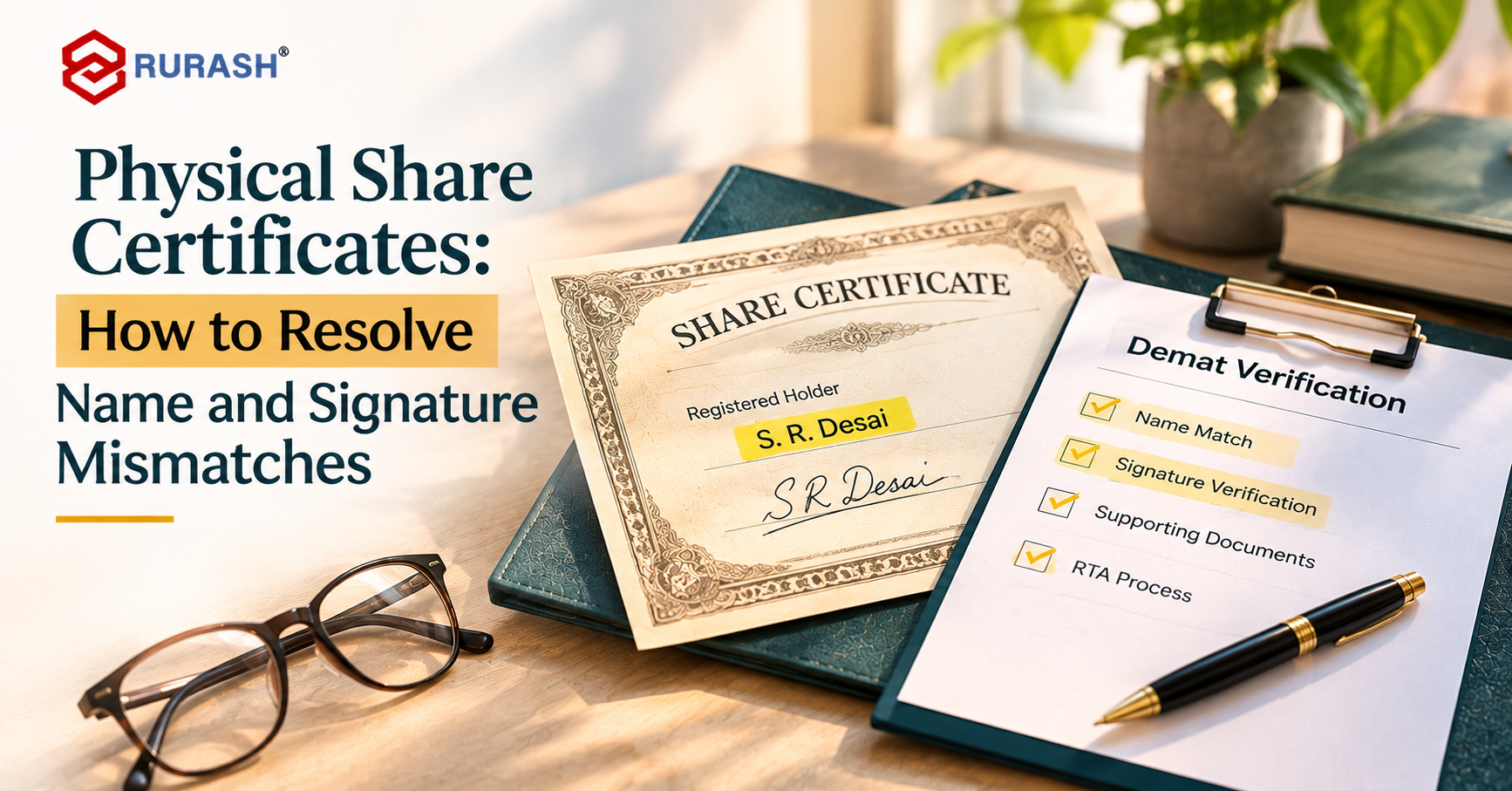
Hero insight: Your shares may be decades old. Your name and signature may have changed. What happens when the records no longer match?
Many Indian families still hold physical share certificates purchased years or even decades ago. These investments may have been made by parents, grandparents or individuals who preferred keeping their shares in paper form.
Today, investors looking to convert those certificates into electronic holdings may face an unexpected challenge.
The name printed on an old certificate may not match the current PAN card. A shareholder may have changed their surname after marriage. An old signature may look different from the one used today.
Sometimes, even small differences in initials, spelling or joint-holder details can create questions during processing.
A physical share certificate may establish an important ownership record, but discrepancies in that record can delay dematerialisation until the applicable verification requirements are satisfied.
The good news is that SEBI has prescribed procedures to address certain name and signature mismatches. Understanding the type of discrepancy and approaching the correct Registrar and Transfer Agent (RTA) can help investors prepare more effectively.
Why Do Name and Signature Mismatches Matter?
When physical shares are submitted for dematerialisation, the relevant records must be reconciled with the shareholder’s identity and demat account details.
The company or its RTA may need to verify the registered holder’s information before processing an applicable service request.
These checks help protect shareholder ownership and reduce the possibility of securities being transferred or credited incorrectly.
However, financial records created several decades ago may not reflect an investor’s current personal information.
For example, a certificate issued in the 1990s may record the holder as S. R. Shah, whereas the PAN card and demat account show Sushil Ramesh Shah.
SEBI’s investor-service FAQ recognises such variations as examples of minor name mismatches that may be addressed through the prescribed supporting documents.
The first step is therefore not to assume that the certificate is invalid.
It is to establish exactly where the records differ.
1. Identify the Type of Name Mismatch
Name differences do not all require the same treatment.
Minor name mismatch
A minor discrepancy may involve initials, abbreviations or variations in the way a name is written.
For example:
Share certificate: S. R. Shah
PAN card: Sushil Ramesh Shah
Demat account: Sushil Ramesh Shah
The investor may be able to establish that the different versions refer to the same person using recognised identity documentation.
SEBI’s guidance provides for obtaining an appropriate self-attested identity or supporting document for minor mismatches.
Major name mismatch or legal name change
A major discrepancy may involve a substantial difference in the recorded name or a formal legal change.
Examples include changes following marriage or divorce, or a legal name change supported by official documentation.
Depending on the circumstances, relevant supporting documents may include a marriage certificate, divorce decree, gazette notification or other prescribed evidence.
The applicable requirements should be confirmed with the company or RTA.
Investor takeaway: Do not use the same documentation approach for every name mismatch. First establish whether the discrepancy is minor or involves a substantive legal change.
2. What Happens When Your Signature Has Changed?
Signatures can change over time.
A person may have signed share certificates or shareholder records several decades ago using a different writing style.
Age, health, changes in handwriting or the adoption of a shorter signature may create differences between the original specimen and the current signature.
SEBI’s procedures distinguish between minor and major signature mismatches.
In a major mismatch, or where the specimen signature is unavailable, the shareholder may need to update the signature records through the prescribed verification process.
According to SEBI’s January 2026 investor-service FAQ, the relevant process may involve Form ISR-1 together with one of the permitted verification routes, including banker’s attestation through Form ISR-2 or in-person verification at the RTA office, subject to the prescribed documents.
This distinction matters because not every signature discrepancy automatically requires the same formality.
Investors should obtain confirmation of the specific deficiency before arranging documentation.
3. What Is Form ISR-2?
Form ISR-2 is used for confirmation of a securities holder’s signature by a banker under the relevant SEBI investor-service procedures.
Where banker’s attestation is applicable, the shareholder may need to provide appropriate bank-account evidence along with the prescribed attestation.
Supporting evidence can include a cancelled cheque bearing the holder’s printed name or an accepted bank passbook or statement, as specified in the applicable requirements.
The bank account used for attestation should correspond to the documentation submitted for the verification process.
However, investors should not assume that ISR-2 is compulsory for every case involving a different-looking signature.
SEBI’s FAQ also describes an alternative involving personal verification before authorised RTA personnel with prescribed original identity documents.
Investor takeaway: Confirm whether banker verification, in-person verification or another applicable procedure is required for your particular case.
4. Why Joint-Holder Details Need Special Attention
Physical share certificates may be held jointly by two or more individuals.
When such shares are converted into demat form, the holder details must be examined carefully.
Potential difficulties may arise if the names are recorded differently, one holder’s signature has changed, or the demat account does not reflect the required ownership arrangement.
For instance, an old certificate might record:
First holder: Rajesh Mehta
Second holder: Anjali Mehta
But the available demat account may list the holders in the opposite order.
The appropriate process may involve an applicable transposition-cum-dematerialisation facility where permitted, rather than simply modifying the certificate or ignoring the difference.
Different situations may require different procedures.
If a joint holder is deceased, the matter may also involve transmission requirements.
Changing the order of existing joint holders is not the same as changing beneficial ownership or replacing a shareholder.
Investors should confirm the appropriate route with the depository participant and the company’s RTA before submitting original certificates.
5. Which Documents Should Investors Organise?
The documentation depends on whether the issue concerns names, signatures, joint holdings, a transmission or another shareholder-service requirement.
The following checklist can help investors begin organising their records.
Document or record | Why it may be needed |
|---|---|
Original physical share certificates | Establishes the existing certificate and shareholder details |
Folio number | Helps locate the company’s historical shareholder record |
PAN card | Supports identity verification |
Aadhaar or other accepted identity proof | May help explain a name variation |
Marriage certificate or legal name-change evidence | May support a formal change of name |
Form ISR-1 | Used for applicable KYC and shareholder-detail updates |
Form ISR-2 | Used where banker’s signature attestation is required |
Bank-account evidence | Supports applicable verification and payment details |
Demat Client Master List or account details | Helps confirm the intended electronic holding account |
Historical RTA correspondence | Identifies previous objections or unresolved requests |
Transmission-related documents | May be required where a registered holder has died |
This is a preparation checklist, not a universal list of mandatory documents.
An investor should submit the forms and evidence appropriate to the actual case, following the current instructions from the RTA and depository participant.
6. How to Approach the Company or RTA
The RTA maintains and processes important shareholder-service records on behalf of the company.
For an investor with old physical certificates, identifying the correct RTA can be one of the most useful first steps.
Start by checking the company’s official investor-relations website.
Locate the current RTA contact details and verify whether the company has changed its name, merged, undergone a demerger or appointed a new RTA.
Next, compare the original certificate details with current identity and demat records.
It can be helpful to prepare a concise description of the mismatch.
For example:
The physical share certificate records my name using initials, while my PAN and demat account show my full name. Please confirm the applicable process and supporting documents required to resolve this discrepancy before dematerialisation.
Include the folio and company details through a verified service channel, but avoid sharing unnecessary confidential information.
Request written clarification of the appropriate process and retain copies of the correspondence.
7. What If the RTA Rejects or Returns the Request?
A returned request does not necessarily mean that the securities cannot be dematerialised.
The RTA or depository participant may identify missing documentation, inconsistent details or unresolved ownership questions.
The investor should examine the stated reason carefully.
If the problem concerns a name mismatch, address that discrepancy using the relevant supporting evidence.
If it concerns the signature, confirm the prescribed verification method.
If it concerns ownership, transmission or an old transfer deed, a different process may be necessary.
Avoid repeatedly resubmitting unchanged documents without addressing the specific deficiency.
Keep the request reference number, rejection communication and any objection memo so the matter can be tracked accurately.
8. Does SEBI’s 2026 Special Window Help?
An important development for holders of certain legacy physical securities is SEBI’s special window for transfer-cum-dematerialization.
Under its 30 January 2026 circular, SEBI opened a window from 5 February 2026 to 4 February 2027 for specified physical securities that were sold or purchased before 1 April 2019 and meet the prescribed conditions.
The framework can also cover eligible transfer requests that were previously rejected or returned because of documentary or procedural deficiencies.
However, this window should not be confused with a general relaxation covering every name or signature mismatch.
It applies to qualifying legacy transfer situations, with specific documentary, ownership-verification and processing requirements.
Disputed transfers and shares already transferred to IEPF are outside the scope of the window.
Eligible securities credited under the special window are also subject to the prescribed one-year lock-in.
Investor takeaway: First identify whether the issue is ordinary dematerialisation, an old unregistered transfer, transmission or IEPF recovery. Each can involve a different process.
9. A Practical Example: An Old Certificate With Changed Personal Details
Consider an investor who purchased physical shares in 1998.
The original certificate records the name as P. S. Desai.
The investor’s current PAN card and demat account record the full name as Priya Sanjay Desai.
The investor’s signature has also changed over time.
In this situation, there are two separate verification questions.
The first concerns whether the two name formats refer to the same person.
The second concerns whether the RTA can verify the shareholder’s current signature against its records.
The investor should not assume that resolving the name difference automatically resolves the signature issue.
Instead, the investor should request the applicable instructions for both discrepancies and complete the required documentation.
This example illustrates why identifying each mismatch separately can make the process easier to manage.
10. Can Investors Avoid Problems Before Submitting Documents?
A careful pre-submission review can help reduce avoidable objections.
Before submitting the original certificates, verify the company and folio details, confirm the RTA’s current contact information and check the names recorded in the demat account.
Ensure that any required forms are completed consistently.
Where supporting documents are necessary, check whether self-attestation, original inspection or another prescribed form of verification applies.
Retain copies of certificates and submission acknowledgements.
Investors should also check whether dividends, bonus shares or corporate actions have affected the historical holding, since these may require separate reconciliation.
Preparation does not guarantee approval, but it can help clarify the required route before the investor begins the formal process.
Physical Shares: Name and Signature Mismatch Checklist
Before approaching the RTA, consider the following questions:
Does the shareholder name match the PAN and demat account?
Is the difference minor, or does it involve a formal name change?
Does the current signature match the RTA’s specimen?
Have the applicable ISR forms and verification routes been confirmed?
Are the original folio and certificate details available?
Do joint-holder names and their order require attention?
Is the issue actually related to transmission or an old transfer?
Is the company or its RTA currently identifiable and contactable?
Have previous rejection letters or objections been retained?
Does the case qualify for an ordinary process or a particular regulatory window?
These checks can help investors understand the documentation issue before initiating dematerialization.
Ranjit Jha’s Perspective — Draft for Approval
Proposed editorial perspective for Ranjit M. Jha, MD & CEO, Rurash Financials. Approval required before attribution.
Physical share certificates often represent investments that families have held for several decades.
During that period, names, signatures, addresses and other personal records may have changed.
When investors begin the dematerialisation process, these differences can create documentation challenges that require careful verification.
The priority should be to identify the exact discrepancy, organise the relevant records and follow the applicable process through the company, RTA and depository participant.
A structured approach to legacy shareholding documentation can help investors understand the steps needed to establish accurate electronic ownership records.
Explore More with Rurash
At Rurash Financials, we understand that resolving documentation issues relating to old physical share certificates can involve several steps.
Name variations, signature mismatches, joint-holder discrepancies and historical shareholder records may need careful review before eligible securities can be dematerialised.
Through our Physical to Demat (P2D) services, investors can seek assistance with understanding documentation requirements, identifying the applicable process and coordinating relevant shareholder-service requests.
Your investment history may be decades old. Your ownership records deserve careful attention.
Connect with Rurash Financials for assistance with physical share documentation and dematerialisation.