
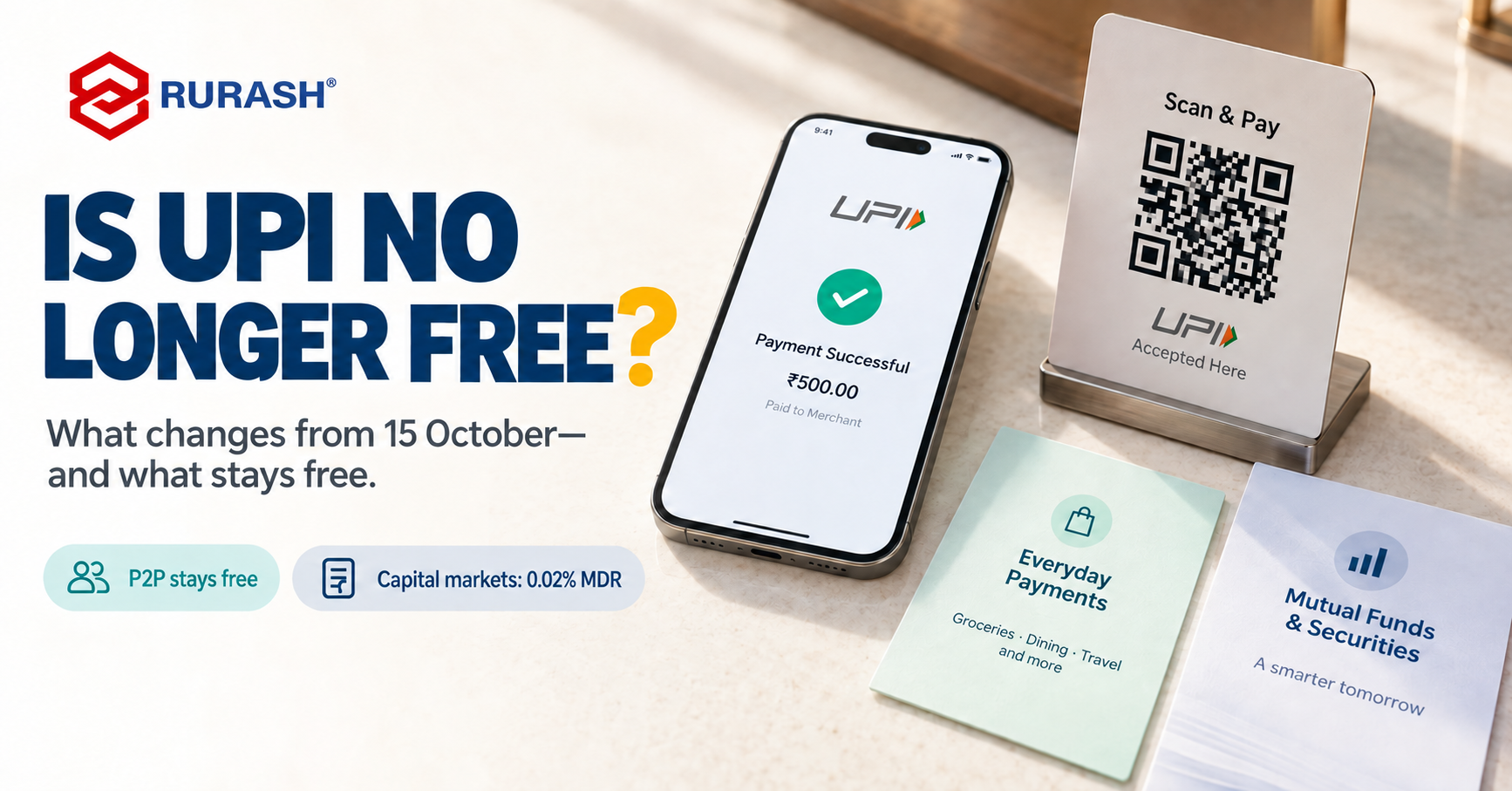
From 15 October 2026, select UPI payments made to merchants will attract a Merchant Discount Rate, or MDR.
The standard charge will be 0.4% on eligible person-to-merchant payments above ₹2,000.
But this does not mean:
“Every UPI payment above ₹2,000 will now cost the customer.”
The more useful question is:
WHO IS RECEIVING THE PAYMENT — A PERSON OR A MERCHANT?
Person-to-person transfers will remain free.
Eligible small merchants will remain exempt, while mutual-fund and securities payments will have a separate, lower MDR of 0.02%, capped at ₹300.
The charge is designed to be paid by the merchant—not directly added to the customer’s UPI payment. Department of Financial Services
Is UPI No Longer Free?
UPI is not becoming chargeable for every transaction.
The new framework distinguishes between:
Person-to-Person → P2P
and
Person-to-Merchant → P2M
Understanding this difference is more important than looking only at the ₹2,000 threshold.
P2P vs P2M
Person-to-Person Payments
These are transfers made directly to another individual.
Examples include:
- Sending money to a family member
- Repaying a friend
- Sharing household expenses
- Transferring funds between personal accounts
These transactions will continue without MDR.
A ₹5,000 transfer to a friend is therefore not treated in the same way as a ₹5,000 purchase from a large merchant.
Person-to-Merchant Payments
These are payments made to businesses for products, services or eligible investments.
Examples may include:
- Shopping at a large retail store
- Paying a large online merchant
- Purchasing electronics
- Paying an insurance premium
- Making an eligible investment payment
Select merchant transactions above ₹2,000 will attract MDR from 15 October.
What Will Merchants Pay?
For an eligible merchant transaction above ₹2,000, the Standard MDR will be 0.4%.
Consider three examples:
₹3,000 payment
MDR paid by the merchant: ₹12
₹50,000 payment
MDR paid by the merchant: ₹200
₹75,000 or more
Maximum MDR: ₹300
Certain categories—including railways, fuel, telecom and insurance—will instead attract a flat ₹5 MDR on applicable transactions above ₹2,000.
But the important distinction remains:
The MDR is a merchant-processing cost—not automatically a customer fee.
Merchants are not permitted to directly pass this charge to customers as an additional UPI fee under the announced framework.
What Remains Free?
The new MDR will not apply uniformly across the UPI ecosystem.
The following will remain free or receive special treatment:
- Person-to-person UPI transfers
- Merchant payments of up to ₹2,000
- Payments to eligible small merchants
- Qualifying small-merchant QR payments in rural and semi-urban areas
- Certain essential categories covered by the flat ₹5 rate
- Capital-market payments covered by the lower 0.02% rate
Small merchants receiving up to ₹1 lakh per month through UPI QR payments are protected under the exemption framework.
This means the everyday neighbourhood payment experience may remain largely unchanged.
What Changes for Mutual-Fund Investors?
Payments for eligible mutual-fund and securities transactions will attract a much lower MDR of:
0.02% — capped at ₹300
For example:
₹10,000 investment → ₹2 MDR
₹50,000 investment → ₹10 MDR
₹1 lakh investment → ₹20 MDR
But these numbers represent the merchant-side processing charge.
They do not mean that a ₹10,000 mutual-fund investment will automatically be reduced to ₹9,998.
The investment platform, intermediary or merchant receiving the payment is expected to bear the MDR.
Will SIPs Become More Expensive?
Not automatically.
Many SIPs are processed through:
NACH • Bank Mandates • Standing Instructions • Other Payment Routes
Only payments routed through an applicable UPI merchant-payment channel may fall within the new MDR structure.
Investors should therefore ask:
“How is my SIP payment processed?”
rather than assuming:
“Every SIP will now carry a UPI charge.”
The new MDR does not change a mutual fund’s:
NAV • Expense Ratio • Tax Treatment • Investment Risk
It is a payment-processing charge—not an additional tax on mutual-fund returns.
What About Stocks and Other Securities?
Eligible capital-market payments made through UPI will also attract the 0.02% MDR, subject to the ₹300 cap.
This may affect payment flows connected with mutual funds, stocks and other covered securities transactions.
However, the new MDR does not replace or modify:
Brokerage • STT • Exchange Charges • Depository Charges • Stamp Duty • Capital-Gains Tax
Investors should avoid mixing payment-processing costs with investment-product costs.
They are not the same.
Two Payments Can Look Similar but Be Treated Differently
Imagine two transactions.
Situation 1
You transfer ₹5,000 to a family member.
Situation 2
You pay ₹5,000 to a large commercial merchant.
Both transactions use UPI.
Both exceed ₹2,000.
But only the second transaction may attract MDR because it is a person-to-merchant payment.
The payment amount alone does not determine the charge.
Recipient → Merchant Category → Transaction Value → Payment Purpose
That is the more useful framework.
Why Has UPI MDR Been Introduced?
UPI processed approximately 24.5 billion transactions worth ₹29.8 trillion in August 2026.
Maintaining a payment network of this scale requires continuous spending on:
Technology • Cybersecurity • Fraud Prevention • Reliability • Dispute Resolution • Customer Support
The MDR is intended to create revenue for the banks, payment applications and service providers supporting the ecosystem.
A portion of the collections will also support wider UPI acceptance among small merchants.
The objective is to improve the financial sustainability of the payment network while keeping most routine transactions free. Reuters
What Does This Mean for Investors?
The change is relevant to investors in two different ways.
First, some investment-related UPI transactions may generate a small merchant-side processing charge.
Second, MDR may improve the revenue economics of:
Banks • Payment Applications • Acquiring Institutions • Payment Aggregators • Fintech Companies
Shares of several payment-related companies rose after the announcement as investors considered the possibility of new fee income. Reuters
But a new revenue stream does not automatically make every payments company an attractive investment.
Investors must still evaluate:
Transaction Volume • Revenue Sharing • Exemptions • Profitability • Competition • Valuation
A positive policy change should begin the research—not complete it.
Four Things UPI Users Should Check
1. Is it a P2P or P2M transaction?
A personal transfer and a merchant payment are treated differently.
2. Does the merchant qualify for an exemption?
Small merchants and some rural or semi-urban payment flows may remain exempt.
3. Which MDR rate applies?
The standard rate, flat ₹5 rate and capital-market rate serve different transaction categories.
4. Is an additional charge being passed to the customer?
Users should question any unexplained or hidden “UPI fee” added directly to their bill.
Ranjit Jha’s Perspective
From the investor-education perspective of Ranjit Jha, MD & CEO of Rurash Financials, the introduction of UPI MDR should be understood as a change in payment infrastructure—not as a new tax on investments.
The distinction between P2P and P2M transactions is important.
So is the distinction between:
Merchant Cost → Investor Cost → Product Cost
For mutual-fund and securities investors, the lower capital-market rate helps preserve convenient digital access while supporting the payment system behind those transactions.
Investors should understand where a cost arises before deciding what it means for their returns.
The Bigger Lesson
UPI became widely accepted because it made digital payments quick, simple and inexpensive.
The new framework attempts to balance two objectives:
Keeping everyday payments accessible
and
Making the payment ecosystem financially sustainable
Most routine users may notice very little change.
But large merchants, payment businesses, banks and investment platforms may need to adjust how they process and account for transactions.
The QR code may look the same. The economics behind it are changing.
Explore More With Rurash
At Rurash Financials, investors can look beyond individual charges and evaluate the complete cost and structure of their investments through:
Mutual Funds • Listed Equity • PMS • Bonds • Portfolio Review • Wealth Management
The objective is not only to ask what an investment may earn.
It is also to understand:
Costs • Risk • Taxation • Liquidity • Portfolio Fit
Understand the transaction. Then understand the investment.
Explore investment and wealth-management opportunities with Rurash Financials.
Final Thought
A UPI payment above ₹2,000 is not automatically chargeable to the customer.
The real question is:
ARE YOU PAYING A PERSON, A MERCHANT OR AN INVESTMENT PLATFORM?
Do not react to the threshold. Understand the transaction.