
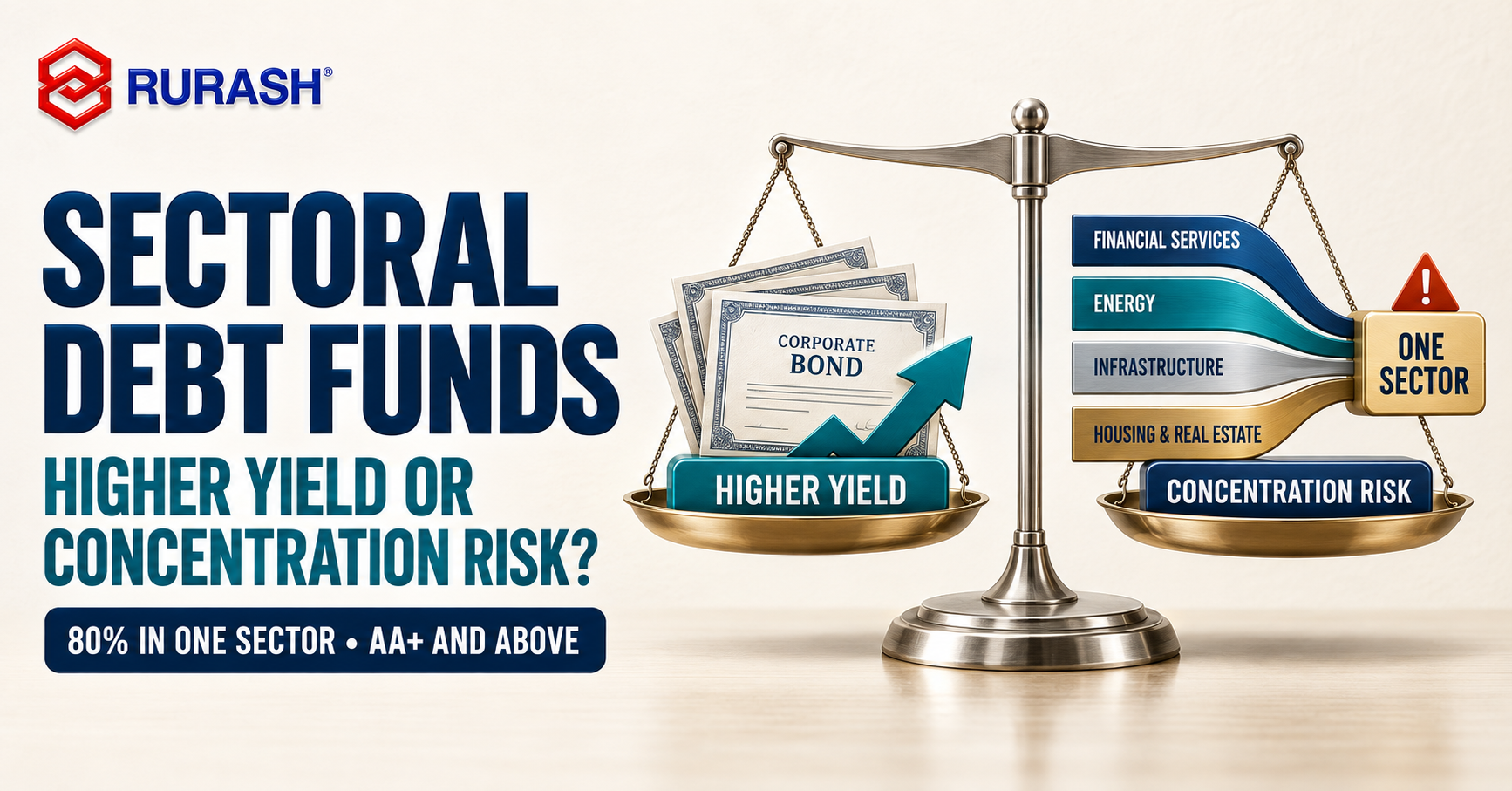
Are sectoral debt funds a higher-yield opportunity or a concentration risk?
Sectoral debt funds may offer investors access to attractive yields available in a particular industry, but they also carry greater concentration risk than diversified debt funds. The category can be useful for informed investors with the right time horizon and portfolio structure; it should not be treated as a universal replacement for conventional debt funds or fixed deposits.
The question has become timely after the Securities and Exchange Board of India introduced sectoral debt funds as a new mutual-fund category through its circular dated 26 February 2026. Fresh scheme activity has now brought the concept closer to investors: SEBI recorded the draft filing for the Bandhan Financial Services Sectoral Debt Fund on 1 September 2026, following other filings in the category.
Under the framework, at least 80% of a sectoral debt fund’s portfolio must be invested in debt securities belonging to one eligible sector. The specified securities must be rated AA+ and above. Eligible sectors include financial services, energy, infrastructure, and housing and real estate. The category was introduced as part of SEBI’s wider rationalisation of mutual-fund schemes and its effort to deepen India’s corporate bond market. (SEBI circular, SEBI draft filing)
What are sectoral debt funds?
A sectoral debt fund is an open-ended debt mutual fund that invests predominantly in bonds and other debt instruments issued within one specified sector.
For example, a financial-services sectoral debt fund could invest across eligible debt issued by banks, non-banking financial companies, housing finance companies and other qualifying financial institutions. It may still diversify across several issuers and securities, but most of its exposure remains connected to the same industry.
This makes the category different from a conventional diversified debt fund, where the fund manager can spread investments across several sectors. It is also different from an equity sector fund: investors are lending to issuers through debt instruments rather than owning their shares. Nevertheless, the health of the chosen sector can still influence credit spreads, liquidity and portfolio valuations.
Why could sectoral debt funds offer higher yields?
Bond yields are not uniform across industries. Demand, liquidity, regulation, borrowing requirements and perceptions of risk can cause bonds from one sector to trade at a higher yield than similar-rated bonds from another.
Traditional debt funds have sector, issuer-group and individual-issuer limits that support diversification. These limits can also restrict a fund manager from taking a large position when one sector appears attractively valued. The new category allows a manager to express that sector view more meaningfully while remaining within a mutual-fund structure.
The current discussion has focused particularly on financial-services debt. Data cited by The Economic Times, based on DSP Mutual Fund analysis as of 31 July 2026, indicated a net yield to maturity of 7.52% for the financial-services/NBFC universe, compared with 6.84% for Banking & PSU funds, 6.99% for Corporate Bond funds and 7.23% for Credit Risk funds. These figures are market observations, not promised investor returns. (Economic Times)
Why does AA+ and above not remove risk?
The high-rating requirement is an important quality filter, but it does not make a sectoral debt fund risk-free.
A credit rating is a current assessment of an issuer’s capacity to meet its obligations. It is not a guarantee. An issuer can be downgraded if its finances deteriorate, while bond prices can fall when markets demand a higher yield. Several highly rated issuers from the same industry may also face a common shock at the same time.
Investors should therefore separate two ideas:
Issuer diversification: The fund may hold bonds from many companies.
Sector diversification: Most of those companies may still depend on the same economic, regulatory or funding environment.
A portfolio can be diversified by issuer and still remain concentrated by sector.
What concentration risks should investors examine?
The main risk is that an adverse sector-wide development can affect a large part of the portfolio together. For a financial-services fund, changes in credit growth, asset quality, liquidity, borrowing costs or regulation may influence several holdings. For infrastructure or real-estate debt, project delays, refinancing conditions, cash-flow uncertainty or policy changes may become relevant.
Investors should also evaluate:
Interest-rate risk
Bond prices generally move inversely to market yields. A portfolio with a longer duration may experience greater NAV movement when interest rates change.
Credit-spread risk
Even without a default, the market may demand additional yield from a sector or issuer. Existing bonds can then lose value.
Liquidity risk
Some corporate bonds may not trade frequently. During stressed periods, selling them at a fair price may become difficult.
Reinvestment risk
Cash received from interest payments or maturing securities may have to be reinvested at lower yields.
Timing risk
A sector can appear attractive because its spreads are unusually wide. If the underlying problem persists or worsens, entering only because of the higher starting yield may prove premature.
Does a higher yield mean a higher return?
No. Yield to maturity is a portfolio-level estimate based on current prices, coupon receipts and assumptions that include holding securities to maturity and receiving scheduled payments. An investor’s realised return can differ because of expenses, credit events, interest-rate movements, portfolio changes, inflows and redemptions, and the investor’s own entry and exit dates.
Therefore, the phrase “higher yield” should be read as higher return potential accompanied by additional risk, not as a guaranteed outcome.
How are sectoral debt funds taxed?
Tax treatment can materially affect the comparison with bonds, fixed deposits and other mutual-fund categories. For units of specified debt-oriented mutual funds acquired on or after 1 April 2023, gains are generally taxed at the investor’s applicable income-tax slab rate, regardless of the holding period, subject to prevailing law and the fund’s final portfolio classification.
Tax rules can change and individual circumstances differ. Investors should verify the scheme’s tax classification and obtain professional tax advice before investing. A higher pre-tax yield may not remain superior after tax.
Who may consider a sectoral debt fund?
The category may be relevant for an investor who:
understands the selected sector and the reason its bonds offer additional yield;
already has a diversified core fixed-income allocation;
can tolerate interim NAV fluctuations;
has an investment horizon aligned with the fund’s duration and strategy; and
wants actively managed sector exposure without selecting individual bonds.
It may be less suitable for investors seeking capital certainty, emergency liquidity, a short and inflexible goal horizon, or a single debt product to provide complete fixed-income diversification.
What should investors check before investing?
Do not evaluate the fund only through its headline yield. Review:
Sector mandate: Which issuers and subsectors qualify?
Portfolio quality: What is the rating mix, and how concentrated are the largest issuers?
Duration: How sensitive could the NAV be to interest-rate changes?
Yield composition: Is the additional yield compensation for duration, liquidity or credit-spread risk?
Exit load and liquidity: Can the investment be accessed when required?
Expense ratio: How much of the portfolio yield may be absorbed by costs?
Tax position: What is the expected post-tax return for the investor?
Portfolio fit: Does the allocation complement existing debt exposure or simply duplicate it?
The right comparison is not “which product has the highest yield?” It is “which product offers the most appropriate post-tax, risk-adjusted outcome for this goal?”
Ranjit Jha’s Perspective
SEBI’s introduction of sectoral debt funds broadens the fixed-income choices available to Indian investors. The category may help investors access sector-specific bond opportunities through a professionally managed structure, but its value cannot be judged from yield alone.
The central question is whether the additional yield adequately compensates for concentration, duration, liquidity and credit-spread risks. A sectoral allocation should generally support a diversified fixed-income portfolio rather than become its foundation.
For investors, yield should follow suitability—not replace it.
Explore More with Rurash
Fixed-income planning requires more than selecting the product with the highest visible yield. It requires comparing credit quality, maturity, duration, liquidity, taxation and the role of each allocation within the wider portfolio.
At Rurash, investors can evaluate mutual funds, bonds and other fixed-income solutions in the context of their risk appetite, liquidity requirements and financial goals.
Because a stronger fixed-income portfolio is built through structure—not yield chasing.